Executive Summary
IEC 60068 is one of the most widely referenced international standards for environmental testing. It provides structured test methods for temperature, humidity, vibration, shock, corrosion, and combined stress conditions. However, IEC 60068 does not prescribe complete qualification programs—it defines individual test methods. Engineering interpretation is required to translate these methods into meaningful industrial qualification strategies.
This white paper outlines how IEC 60068 should be interpreted, structured, and implemented within industrial qualification programs, including automotive, aerospace, electronics, energy, and industrial equipment validation.
1. What IEC 60068 Actually Defines
IEC 60068 is a collection of standardized environmental test methods rather than a single qualification roadmap. It includes procedures such as:
– IEC 60068-2-1 (Cold)
– IEC 60068-2-2 (Dry Heat)
– IEC 60068-2-14 (Temperature Change)
– IEC 60068-2-30 (Damp Heat Cyclic)
– IEC 60068-2-78 (Damp Heat Steady State)
– IEC 60068-2-6 (Vibration)
– IEC 60068-2-11 (Salt Mist)
These methods define test conditions, durations, and acceptance logic—but not how to combine them into a qualification plan.
2. From Test Method to Qualification Program
Industrial qualification programs must interpret IEC 60068 methods based on:
– Intended operating environment
– Product lifecycle expectations
– Failure mode analysis
– Regulatory or OEM requirements
Engineering judgment is required to sequence tests, determine severity levels, and define pass/fail criteria.
3. Severity Levels and Tailoring
IEC 60068 allows tailoring of temperature ranges, ramp rates, humidity levels, and durations. Industrial qualification programs must define severity based on real operating conditions, not arbitrary maximum values. Over-testing may introduce unrealistic failure modes, while under-testing reduces reliability assurance.
4. Sequencing and Combined Stress
IEC 60068 methods are often executed sequentially; however, modern qualification strategies may require combined stress testing (e.g., vibration under temperature, humidity followed by thermal cycling). Engineering environmental systems must support programmable multi-segment profiles and repeatable transitions.
5. Infrastructure Requirements
Proper implementation requires environmental chambers with:
– Verified temperature uniformity
– Controlled humidity generation
– Ramp rate stability
– Structural durability
– Corrosion-resistant construction
Digital controllers must support programmable test sequences and secure data logging.
6. Digital Traceability and Audit Readiness
Industrial qualification programs increasingly require audit-ready data. Environmental systems must log test profiles, alarm events, deviations, and test durations. CME systems powered by enviCoM™ 4.0 enable secure data storage, programmable logic, and remote diagnostics through Levito digital services.
7. Common Misinterpretations of IEC 60068
– Treating individual test methods as complete qualification programs
– Selecting maximum severity without environmental justification
– Ignoring sequencing effects between humidity and temperature
– Overlooking airflow uniformity requirements
– Failing to document deviations properly
Correct interpretation ensures reliability validation aligns with real-world conditions.
Conclusion
IEC 60068 provides a powerful framework for environmental testing, but its value depends on correct interpretation. Industrial qualification programs must translate test methods into structured, severity-aligned, and sequenced validation plans.
CME engineers environmental test systems that support IEC 60068-based qualification programs through precise control, scalable architecture, combined stress capability, and digital traceability.
Choosing the Right Chamber
Selecting the appropriate environmental test chamber is critical to achieving reliable, repeatable, and standards-compliant test results. The ideal solution depends on your product dimensions, applicable test standards, environmental conditions, throughput requirements, and future expansion plans. The following guide provides a practical overview of common chamber types and their typical applications.
Reach-In Environmental Test Chambers
Reach-in environmental test chambers are the most versatile solution for research laboratories, quality assurance departments, and product development teams. They are ideal for testing small to medium-sized components such as electronic assemblies, sensors, automotive parts, battery modules, and medical devices. Their compact footprint, excellent temperature uniformity, and relatively low operating costs make them suitable for routine qualification testing under standards such as IEC 60068, MIL-STD-810, and JEDEC.
Typical Applications
- Electronic components
- Automotive ECUs
- Battery modules
- Medical devices
- Industrial control systems
Walk-In Environmental Test Chambers
Walk-in environmental test chambers are designed for testing large assemblies, complete products, or multiple specimens simultaneously. They offer greater flexibility for automotive, aerospace, defence, renewable energy, and industrial equipment manufacturers where product dimensions exceed the capacity of standard reach-in chambers.
Their modular construction also allows future expansion as testing requirements evolve.
Typical Applications
- Automotive assemblies
- Battery packs
- Solar panels
- Aerospace equipment
- Large industrial products
Benchtop Environmental Test Chambers
Benchtop chambers provide precise environmental control within a compact footprint. They are particularly suited to laboratories with limited space or organisations performing component-level research, validation, and accelerated life testing.
Despite their size, modern benchtop chambers can deliver excellent temperature stability and repeatability for small test specimens.
Typical Applications
- PCB testing
- Semiconductor devices
- Sensors
- MEMS devices
- Small electronic components
Altitude Test Chambers
Altitude test chambers simulate reduced atmospheric pressure experienced at high elevations or during air transport. These chambers enable manufacturers to evaluate the performance, safety, and reliability of products exposed to low-pressure environments while simultaneously controlling temperature.
Typical Applications
- Aerospace components
- Avionics
- EV batteries
- Electronics transported by air
- Defence equipment
Thermal Shock Test Chambers
Thermal shock chambers rapidly transfer specimens between hot and cold environments to evaluate resistance to sudden temperature changes. These systems accelerate thermal fatigue and identify failures caused by differential expansion between materials.
Typical Applications
- Electronics
- Automotive components
- Aerospace systems
- Connectors
- Power electronics
Solar PV Module Test Chambers
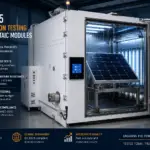
Solar PV module test chambers are specifically engineered to perform qualification testing in accordance with standards such as IEC 61215 and IEC 61730. These chambers support damp heat, thermal cycling, humidity freeze, and related environmental tests required for photovoltaic module certification.
Typical Applications
- PV module manufacturers
- Certification laboratories
- Research institutes
- Renewable energy companies
Battery Test Chambers
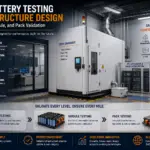
Battery test chambers provide safe environmental testing for lithium-ion cells, modules, and battery packs. In addition to precise temperature and humidity control, they incorporate safety features such as pressure relief systems, gas monitoring, explosion protection options, emergency shutdown systems, and specialised electrical feedthroughs.
Typical Applications
- EV battery qualification
- Battery R&D
- Energy storage systems
- Consumer electronics
- Aerospace batteries
Solar Simulation Test Chambers
Solar simulation chambers combine environmental control with controlled solar radiation to replicate real-world operating conditions. They are widely used for testing photovoltaic modules, automotive components, building materials, and products exposed to prolonged sunlight.
By integrating temperature, humidity, and irradiance into a single system, these chambers provide highly realistic accelerated ageing conditions.
Typical Applications
- Solar PV testing
- Automotive interiors
- Exterior coatings
- Composite materials
- Building products
Combined Environmental & Mechanical Test Systems
Certain qualification programmes require simultaneous exposure to environmental conditions and mechanical loading. Combined environmental and mechanical test systems integrate environmental chambers with hydraulic, servo-electric, or electromechanical loading equipment to evaluate structural performance under realistic operating conditions.
These systems are commonly used for composite insulators, structural components, aerospace materials, and specialised industrial applications.
Typical Applications
- Composite insulators
- Aerospace structures
- Rail components
- Industrial materials
- Custom qualification programmes
Corrosion Test Chambers
Corrosion test chambers accelerate the effects of corrosive environments through salt spray, cyclic corrosion, condensation, and humidity exposure. These chambers help manufacturers assess protective coatings, material selection, and long-term corrosion resistance.
Typical Applications
- Automotive components
- Fasteners
- Marine equipment
- Defence products
- Surface coatings
Dust Test Chambers
Dust ingress chambers evaluate enclosure protection against fine particulate contamination in accordance with standards such as IEC 60529 (IP5X/IP6X). Controlled dust circulation enables manufacturers to verify product sealing effectiveness under simulated desert and industrial environments.
Typical Applications
- Electrical enclosures
- Automotive electronics
- Outdoor equipment
- Industrial controls
- Consumer electronics
Rain Test Chambers
Rain test chambers simulate rainfall, water spray, and wind-driven precipitation to verify enclosure integrity and ingress protection ratings. Test parameters can be configured to satisfy IEC 60529, ISO, MIL-STD, and customer-specific requirements.
Typical Applications
- Automotive components
- Outdoor electronics
- Telecom equipment
- Defence systems
- Electrical enclosures
MIL-STD Sand & Dust Test Chambers
MIL-STD sand and dust chambers reproduce severe desert environments by circulating calibrated sand or dust particles under controlled airflow conditions. These chambers are designed to meet military qualification requirements, including MIL-STD-810, helping manufacturers evaluate equipment durability in harsh operating environments.
Typical Applications
- Defence equipment
- Military vehicles
- Aerospace systems
- Tactical electronics
- Outdoor industrial products
Air Stream Units
Air stream units deliver precisely conditioned hot or cold air directly onto a test specimen, enabling rapid temperature changes without placing the entire product inside an environmental chamber. They are particularly valuable for semiconductor testing, electronics validation, and thermal characterisation.
Typical Applications
- Semiconductor testing
- PCB validation
- Electronic assemblies
- Thermal characterisation
- Component-level qualification
Remote Conditioning Units (RCUs)
Remote Conditioning Units (RCUs) separate the environmental conditioning equipment from the test enclosure, allowing conditioned air to be supplied through insulated ducting. This approach is ideal for large or specialised test rigs where conventional environmental chambers are impractical.
RCUs provide exceptional flexibility for integrating environmental control with existing test facilities, dynamometers, vibration systems, and custom research equipment.
Typical Applications
- Brake dynamometers
- Engine test cells
- Large test rigs
- Aerospace test facilities
- Custom environmental conditioning systems