


Battery Altitude Test Chambers
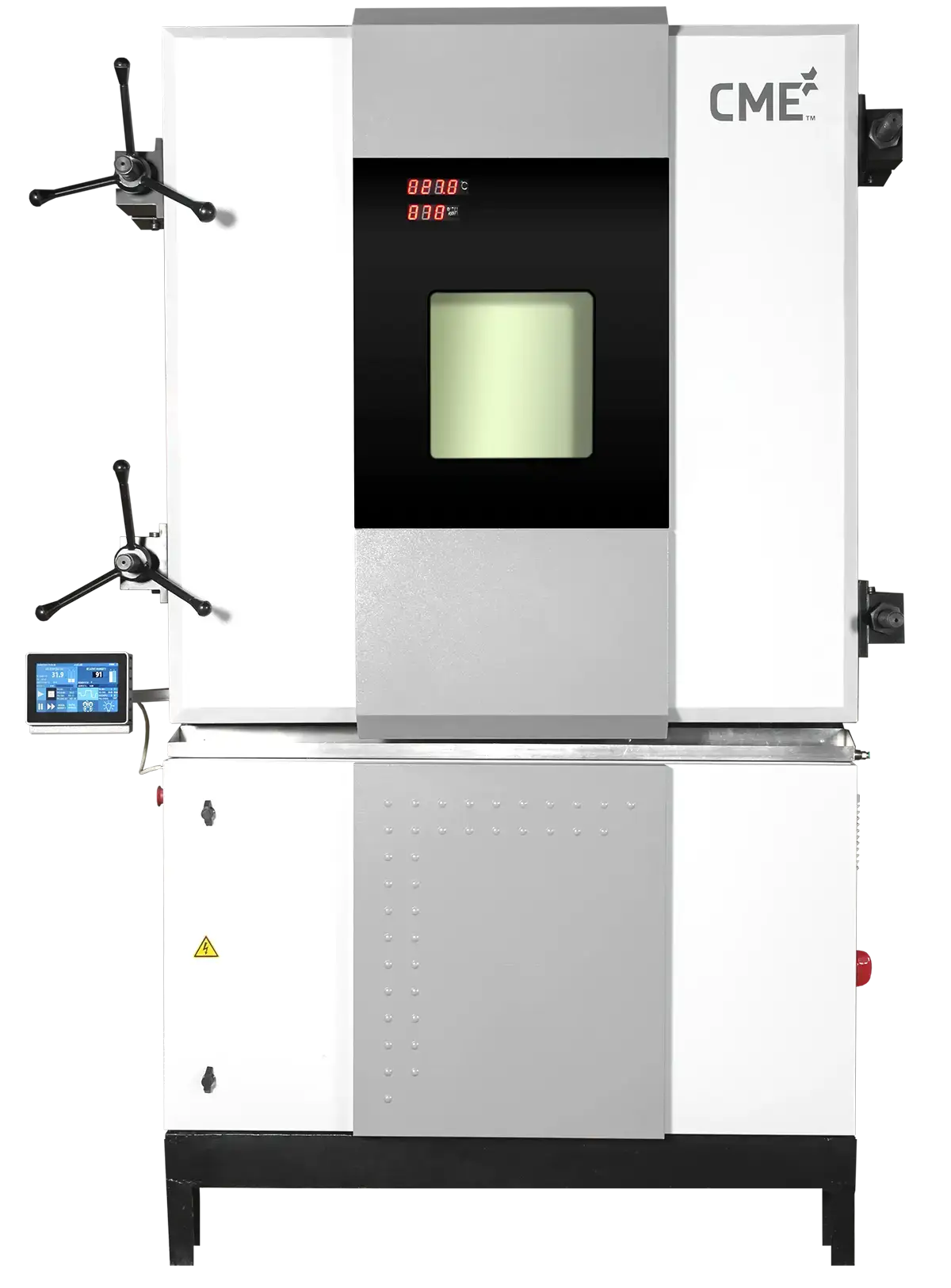
CME Battery altitude chambers combine environmental control (–70°C to +150°C) with programmable pressure profiles to simulate altitudes up to aviation-relevant conditions. Integrated safety architecture ensures controlled monitoring of battery behavior during charge-discharge cycles at reduced pressure. For advanced EV validation and aerospace battery systems, altitude testing also supports EUCAR hazard-level assessment under low-pressure conditions, where gas expansion and combustion risk can increase due to atmospheric changes.
Why Altitude Testing Is Critical for Modern Batteries
Innovation Rooted in Engineering Depth
Reduced atmospheric pressure at altitude affects heat dissipation, gas behavior, insulation performance, and safety margins, making altitude testing essential for reliable battery validation.
Purpose-Built Battery Altitude Test Chambers
CME Battery Altitude Test Chambers are purpose-engineered to combine precise environmental control with controlled low-pressure simulation.
Unlike conventional altitude chambers adapted for batteries, CME systems integrate battery specific safety architecture, thermal performance, and digital intelligence from the ground up.
Safety First Design for Low-Pressure Battery Testing
Altitude testing introduces additional safety challenges due to altered gas expansion behavior, reduced convective cooling, and increased risk during fault conditions.
CME chambers incorporate reinforced pressure-rated construction, controlled pressure ramps, redundant interlocks, pressure relief mechanisms, and continuous safety-state monitoring.
Thermal Control Under Reduced Pressure
Reduced air density significantly impacts heat transfer during battery operation.
CME altitude battery chambers are engineered with optimized airflow strategies, high-capacity refrigeration systems, and intelligent control logic to maintain stable temperatures even at simulated high altitudes.
Digital Intelligence with enviCoM™ 4.0
AI-Enabled, Data-Driven Altitude Testing
Evaluate Battery Performance at Altitude
Define low-pressure, thermal, and safety requirements for battery testing under altitude conditions.
| Models | AT225BT | AT560BT | AT1000BT | AT1500BT | |||
|---|---|---|---|---|---|---|---|
|
Test Space Dimension |
in mm (WxDxH) |
500 x 600 x 750 |
780 x 800 x 940 |
1000 x 1000 x 1000 |
1000 x 1500 x 1000 |
||
|
in inches (WxDxH) |
20 x 24 x 30 |
31 x 31 x 37 |
39 x 39 x 39 |
39 x 59 x 39 |
|||
|
Test Space
Volume |
in Ltrs |
225 |
560 |
1000 |
1500 |
||
|
in Cu.ft |
8 |
20 |
35.3 |
53 |
|||
|
Temperature
Range |
in °C |
- 60 to +120 |
|||||
|
in °F |
-76 to +248 |
||||||
|
Ramp Rate |
|
1/2/3/4/5 |
|||||
|
Altitude Range
|
|
Upto 10 mbar (Default)
Upto 1 mbar (Optional)
|
|||||
|
Humidity |
|
Optional |
|||||
|
Customized ramp rates are also available |
|||||||
|
EUCAR 0 to 7 Safety Level options based on severity
|
Fresh Air Exchange system
Nitrogen Purge
Pressure Relief Valve
Gas Monitoring System
Fire suppression system
Magnetic Door lock
|
||||||
Flexible Configurations: Reach-In and Walk-In
CME Battery Altitude Test Chambers are available in reach-in and walk-in configurations. Systems can be configured for battery cells, modules, packs, or subsystems, with customized pressure ranges, temperature profiles, safety systems, and instrumentation.Typical Applications
- EV battery validation for mountainous and high-altitude regions
- Aerospace and defense battery systems
- Battery transport and air-freight simulation
- Safety and abuse testing under reduced pressure
- Energy storage systems deployed at elevation
Why CME for Battery Altitude Testing?
- Integrated altitude, thermal, and safety engineering
- Stable temperature control under reduced pressure
- Digital-first controls and real-time intelligence
- Scalable customization without one-off risk
- Strong lifecycle and service support via Levito
Why is altitude simulation important for EV battery testing?
At higher altitudes, atmospheric pressure decreases, which can impact battery enclosure integrity, electrolyte behavior, venting systems, and safety performance. Altitude testing ensures batteries remain safe and functional during transportation and operation in mountainous regions.
What standards require altitude testing for lithium-ion batteries?
Common standards include UN 38.3 (Transport of Dangerous Goods), IEC 62133, UL standards, and various automotive OEM validation protocols. UN 38.3 specifically mandates low-pressure (altitude) simulation testing for lithium batteries.
How does low-pressure affect lithium-ion batteries?
Low atmospheric pressure can cause battery swelling, leakage, seal failure, or vent activation due to internal pressure differences. Altitude testing verifies structural integrity and safety mechanisms under reduced external pressure.
What is the typical test procedure for altitude simulation?
The battery is placed inside the chamber, and pressure is gradually reduced to simulate high altitude (for example, 11.6 kPa for UN 38.3). The battery remains under low pressure for a specified duration, often 6 hours or more, while being monitored for leakage, rupture, fire, or explosion.
Are altitude chambers vacuum-based systems?
Yes. Altitude simulation chambers use vacuum pumps and pressure control systems to reduce internal chamber pressure while maintaining controlled temperature conditions.
What safety features are included in altitude battery test chambers?
Safety features typically include explosion-proof interiors, reinforced chamber walls, pressure relief systems, gas exhaust ports, fire suppression systems, interlock safety controls, and real-time monitoring of pressure and temperature.
Can full EV battery packs be tested in altitude chambers?
Yes, provided the chamber is designed with sufficient internal volume and load capacity. Large walk-in altitude chambers are available for module and full battery pack testing.
Can altitude chambers perform rapid decompression tests?
Yes. Some systems allow controlled rapid decompression to simulate sudden altitude changes, such as those experienced during air cargo transport or aviation scenarios.
Is humidity control possible in altitude simulation chambers?
Humidity control is generally limited under very low-pressure conditions because water vapor behavior changes significantly. Most altitude tests focus on temperature and pressure, but some systems can provide controlled humidity at moderate pressure levels.
Can altitude chambers be integrated with battery charge-discharge systems?
Yes. Advanced systems allow integration with battery cyclers to perform electrical performance testing under combined altitude and temperature stress conditions.
Battery Testing Related Products
Battery Walk-In Test Chambers
Battery Walk-In Test Chambers CME’s chambers support industry standards including IEC 62660, ISO 16750, UN 38.3, and OEM-specific EV qualification protocols. For advanced mobility platforms, chambers are engineered to accommodate
Battery Reach-In Test Chambers
Battery Reach-In Test Chambers CME’s Battery Test Chambers are engineered to support EUCAR hazard level evaluation (Levels 0–7) testing through reinforced chamber construction, explosion-rated pressure relief systems, controlled venting architecture, and