


CO₂ Refrigeration Technology for Environmental Test Chambers
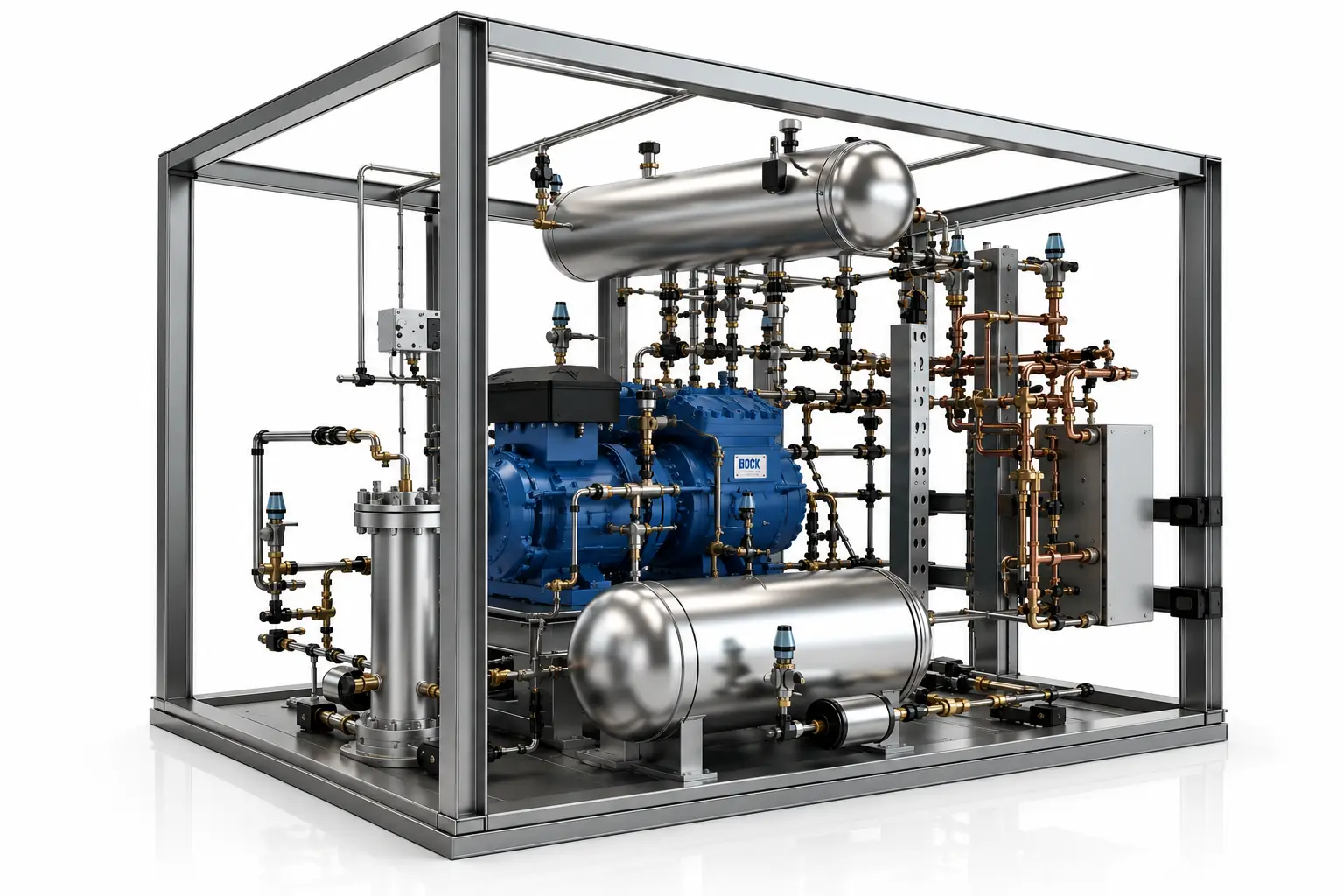
CME has developed and internally validated a CO₂-based refrigeration system capable of supporting environmental chamber temperatures down to –45°C, as part of its broader R&D programme focused on lower-impact and future-ready refrigeration technologies.
The Refrigeration Challenge
Environmental test chambers must maintain precise and repeatable temperature conditions, often while managing changing product loads, heat generation and rapid temperature transitions. Achieving reliable performance at temperatures as low as –45°C places significant demands on the refrigeration system.
Conventional low-temperature chamber systems commonly rely on synthetic refrigerants and multi-stage refrigeration architectures. While these technologies are proven, manufacturers increasingly need to consider refrigerant availability, environmental impact, energy efficiency, regulatory transition and long-term serviceability.
Moving to a natural refrigerant such as CO₂ is not a simple refrigerant replacement. CO₂ operates at significantly higher pressures and requires a different approach to component selection, piping design, heat exchange, pressure protection, control logic and system safety.
The engineering challenge was therefore clear
How can a CO₂-based refrigeration system be designed to deliver stable, repeatable and reliable environmental chamber performance down to –45°C?
CME initiated this development programme to explore a lower-impact and future-ready refrigeration architecture for environmental testing applications. The objective was not only to reach the required temperature, but to develop a system capable of maintaining chamber stability, managing variable test loads and operating safely under demanding industrial conditions.
This required CME’s engineering team to address several critical areas, including:
- high-pressure refrigeration design;
- low-temperature pull-down performance;
- precise temperature control;
- heat exchanger optimisation;
- system safety and pressure management;
- component integration;
- reliability under repeated thermal cycles;
- serviceability and long-term maintainability.
The result is a fully developed CO₂-based refrigeration platform designed for environmental chambers operating down to –45°C, representing an important step in CME’s ongoing work toward more sustainable and future-ready testing technologies.
Why CME Developed a CO₂-Based Refrigeration Platform





The development programme focused on several key objectives:
Achieve stable chamber operation down to –45°C using CO₂ refrigeration.
Develop an indigenous refrigeration platform engineered and integrated by CME.
Investigate a lower global warming potential (GWP) alternative to conventional refrigerants.
Design a system that prioritises safety, reliability and long-term serviceability.
Build a scalable technology platform that can support future generations of environmental test chambers.
Strengthen India’s engineering capability in advanced environmental simulation technologies.
Inside the Technology
Developing a CO₂-based refrigeration platform for ultra-low-temperature environmental test chambers required far more than selecting a different refrigerant. The unique thermodynamic characteristics of CO₂ demanded a complete re-evaluation of the refrigeration system architecture, component selection and control philosophy.
CME’s engineering team adopted a system-level design approach, ensuring that every subsystem worked together to deliver reliable chamber performance, precise temperature control and safe operation under demanding industrial conditions.
Refrigeration System Engineering
The refrigeration platform was designed specifically to support environmental testing applications operating down to –45°C. Every major subsystem was carefully engineered to optimise thermal performance, operational reliability and serviceability while accommodating the higher operating pressures associated with CO₂ refrigeration.
Development focused on
Refrigeration circuit architecture
High-pressure system design
Heat exchanger optimisation
Compressor and expansion device integration
Refrigerant flow management
Thermal load balancing
Chamber pull-down performance
Long-duration operational stability
Why CO₂ Refrigeration Matters
The refrigeration industry is undergoing a significant transformation as manufacturers across the world seek technologies that balance performance, environmental responsibility and long-term sustainability. Natural refrigerants are increasingly becoming part of this transition, with carbon dioxide (R744) emerging as one of the most promising options for industrial refrigeration applications.
Unlike many conventional synthetic refrigerants, CO₂ is a naturally occurring refrigerant with a Global Warming Potential (GWP) of 1 and Zero Ozone Depletion Potential (ODP). These characteristics make it an attractive option for organisations looking to adopt refrigeration technologies aligned with future environmental objectives.
For manufacturers of environmental test chambers, however, adopting CO₂ is not simply an environmental decision—it is an engineering challenge. Its unique thermodynamic properties require specialised system design, high-pressure components, advanced control strategies and careful optimisation to achieve reliable low-temperature operation.
By investing in the development of CO₂ refrigeration technology, CME is building capabilities that extend beyond a single product. The programme reflects the company’s commitment to advancing refrigeration engineering while preparing for the next generation of environmental testing solutions.
CME's Vision
At CME, sustainability is not viewed as a standalone feature but as an engineering objective integrated into product development.
The CO₂ refrigeration programme represents an important milestone in CME’s long-term technology roadmap. By investing in indigenous research, advanced refrigeration engineering and intelligent environmental testing systems, CME aims to develop solutions that deliver both technical excellence and environmental responsibility.
As the industry evolves, CME remains committed to developing innovative technologies that help laboratories, manufacturers and research organisations meet tomorrow’s testing requirements with confidence.
Development & Validation Status
Innovation is a continuous engineering process. Every new technology must progress through research, design, testing, validation and real-world deployment before reaching full commercial maturity.
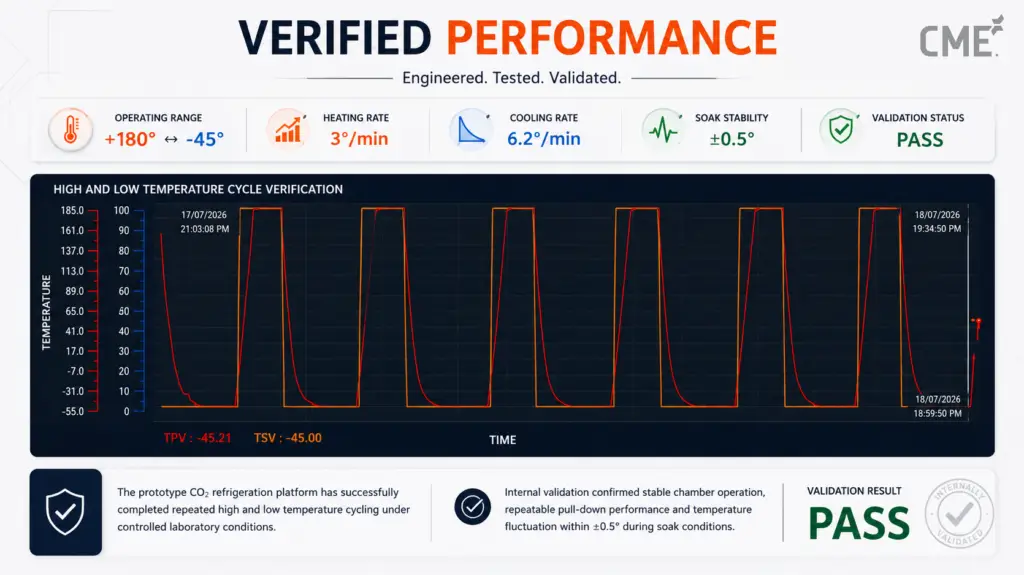
The CO₂ refrigeration platform developed by CME has successfully completed its core engineering and prototype development phases and is currently progressing through performance validation as part of the company’s product development roadmap.
Each stage of development has been approached using the same engineering principles that guide every CME environmental chamber—precision, reliability, safety and long-term performance.
Current Development Status / Engineering Validation
| Development Stage | Status |
|---|---|
| Concept Development | ✔ Completed |
| System Architecture & Engineering Design | ✔ Completed |
| Mechanical & Refrigeration Design | ✔ Completed |
| Prototype Development | ✔ Completed |
| Control System Integration | ✔ Completed |
| Internal Functional Testing | ✔ Completed |
| Performance Validation | ✔ In Progress |
| Extended Reliability Testing | Planned |
| Customer Pilot Installation | Planned |
| Commercial Launch | Under Evaluation |
The prototype platform has been developed to verify the feasibility of applying CO₂ refrigeration technology to environmental testing applications operating down to –45°C.
Current validation activities are focused on evaluating:
- Temperature pull-down characteristics
- Chamber temperature stability
- Control system performance
- Refrigeration system reliability
- Safety and protective functions
- Repeatability across multiple operating cycles
- Overall system performance under controlled test conditions
The insights gained during this phase will be used to further optimise the platform before customer deployment.
Ready to Explore CO₂ Refrigeration?
Our CO₂ refrigeration platform represents the next step in sustainable environmental testing. If you’re evaluating future-ready testing infrastructure or would like to discuss a pilot application, our engineering team would be happy to connect.