


Cyclic Corrosion Test Chambers (CCT)
Accelerated, Real-World Corrosion Simulation Through Controlled Cycles. Cyclic Corrosion Test Chamber (CCT) also know as Cyclic Salt Spray Test Chambers. While traditional salt spray testing provides baseline corrosion resistance data, real-world environments expose materials and assemblies to cyclic conditions, wetting, drying, humidity, temperature variation, and salt exposure.
All CCT options upgradeable onsite | Future Proof | Compliant Corrosion Testing | ASTM G85 | ISO 16701 | SAE J2334| MIL STD 750 1046.3 | VDA 621-415 | P-VW1210

Moving Beyond Static Salt Spray Testing
Innovation Rooted in Engineering Depth
CME Cyclic Salt Spray Chambers—also known as Cyclic Corrosion Test (CCT) Chambers—are engineered to replicate these complex, real-world corrosion mechanisms through precisely controlled environmental cycles.
Purpose-Built for Cyclic Corrosion Testing
CME CCT Chambers integrate salt spray, controlled humidity, drying, and temperature control within a single, unified testing platform.
Unlike basic salt spray systems, CME chambers are designed to execute programmable test sequences that more accurately represent field corrosion behavior.
Compliance with Global Cyclic Corrosion Standards
ASTM G85 (AASS, Prohesion and related methods)
- ISO 16701
- VDA 621-415
- SAE J2334
- OEM-specific automotive corrosion standards
Precise Control of Corrosion Test Cycles
CME chambers provide precise control over each phase of the corrosion cycle—salt spray exposure, humidity dwell, dry-off, and temperature transitions.
Uniform spray distribution, stable humidity control, and repeatable temperature performance ensure consistent and comparable test results.
Typical Applications Automotive body-in-white and assemblies
Fasteners, brackets, and coated components
EV battery enclosures and housings
Chassis, suspension, and underbody parts
Industrial equipment and outdoor components
Replicate Real-World Corrosion Cycles
Work with CME engineers to design cyclic corrosion profiles matching OEM specifications.
| Models | SF-450-CCT | SF-1000-CCT | |||
|---|---|---|---|---|---|
|
Test Space Dimensions
with Hood |
in mm (WxDxH) |
850 x 730 x 1300 [868 Ltrs] |
1680 x 800 x 1400 [1678 Ltrs] |
||
|
in inches (WxDxH) |
31.5 x 29 x 51 [ 30.6 Cuft] |
66 x 31.5 x 55 [59.2Cuft]
|
|||
|
Test Space Dimensions
without Hood |
in mm ( WXDXH) |
850 x 730 x 820 [519 Ltrs] |
1680 x 800 x 890 [951 Ltrs] |
||
|
in inch ( WXDXH) |
33.5 x 29 x 32 [18.3 Cuft] |
66 x 31.5 x 35 [33.6 Cuft] |
|||
|
External Dimensions |
in mm (WxDxH) |
1720 x 1370 x 1520 |
2538 x 1525 x 1625 |
||
|
in inch (WXDXH) |
68 x 54 x 60 |
100 x 60 x 64 |
|||
|
Temperature Range |
in °C |
Max Temperature +60 |
|||
|
in °F |
Max Temperature +140 |
||||
| Test Standard | Standard Origin Industry/Country | Procedure | Salt Spray (SS) | Dry Cycle w Humidity (DCH) | IMM | Spray Header (SH) | Oscillating Spray Header (OSH) | SO2 Dosing (SO2) | Refrigeration System +20°C (REF20) | Refrigeration System -40°C (REF-40) | Wall Wash (WW) |
|---|---|---|---|---|---|---|---|---|---|---|---|
|
ASTM B-117 |
American |
"Salt Spray - Chamber Temperature - 35°C; Saturator Temperature - 45°C
Exposed to a continuous indirect spray of neutral (pH 6.5 to 7.2) salt water solution, which falls-out on to the specimens at a rate of 1.0 to 2.0ml/80cm²/hour, in a chamber temperature of +35C. " |
|
|
|
|
|
|
|
|
|
|
ASTM B-287 |
American |
"Salt Spray - Chamber Temperature - 35°C; Saturator Temperature - 45°C
Exposed to a continuous indirect spray of acidified (pH 3.1 to 3.3) salt water solution, which falls-out on to the specimens at a rate of 0.75 to 2.0ml/80cm²/hour, in a chamber temperature of +35C. " |
|
|
|
|
|
|
|
|
|
|
ASTM B-368 |
American |
"Salt Spray - Chamber Temperature - 49°C; Saturator Temperature - 60°C
Exposed to a continuous indirect spray of acidified (pH 3.1 to 3.3) salt water solution, which falls-out on to the specimens at a rate of 1to 2.0ml/80cm²/hour, in a chamber temperature of +49C. " |
|
|
|
|
|
|
|
|
|
|
ASTM D-1735 |
American |
"Salt Spray - Chamber Temperature - 38°C; Saturator Temperature - 45°C
Exposed to a continuous indirect spray water, which falls-out on to the specimens at a rate of 1.5 to 3.0ml/80cm²/hour, in a chamber temperature of +38C" |
|
|
|
|
|
|
|
|
|
|
ASTM D-2247 |
American |
"High Humidity - Chamber Temperature 38°C; Humidity 100%Rh
Test specimens are placed in an enclosed chamber and exposed to constant conditions of +38°C and constant condensation humidity level of 100% RH." |
|
|
|
|
|
|
|
|
|
|
ASTM G43 |
American |
"Salt Spray - Chamber Temperature - 49°C; Saturator Temperature - 60°C.
High Humidity – Chamber Temperature 49°C; Humidity 100%Rh
Exposed to a continuous indirect spray of acidified (pH 2.8 to 3) synthetic sea water solution, which falls-out on to the specimens at a rate of 1 to 2ml/80cm²/hour, in a chamber temperature of +49C. followed by a high humidity condensation at 49°C and 100%RH." |
|
|
|
|
|
|
|
|
|
|
ASTM G44 |
American |
Immersion - Test specimens are immersed in a neutral 3.5% Sodium Chloride Solution and then allowed to dry |
|
|
|
|
|
|
|
|
|
|
ASTM G85, Annex 1 |
American |
"Salt Spray - Chamber Temperature - 35°C; Saturator Temperature - 45°C
Exposed to a continuous indirect spray of acidified (pH 3.1 to 3.3) salt water solution, which falls-out on to the specimens at a rate of 1.0 to 2.0ml/80cm²/hour, in a chamber temperature of +35C. " |
|
|
|
|
|
|
|
|
|
|
ASTM G85, Annex 2 |
American |
"Salt Spray - Chamber Temperature - 49°C; Saturator Temperature - 60°C.
Dry Cycle - 49°C,
High Humidity – Chamber Temperature 49°C; Humidity 95%Rh
Exposed to a continuous indirect spray of acidified (pH 2.8 to 3.0) salt water solution, which falls-out on to the specimens at a rate of 0.5 to 3.0ml/80cm²/hour, in a chamber temperature of +49C. Air drying at 49°C, followed by a high humidity soak at 49°C and 95%Rh." |
|
|
|
|
|
|
|
|
|
|
ASTM G85, Annex 3 |
American |
"Salt Spray - Chamber Temperature - 49°C; Saturator Temperature - 60°C.
High Humidity – Chamber Temperature 49°C; Humidity >98%Rh
Exposed to a continuous indirect spray of acidified (pH 2.8 to 3.0) salt water solution, which falls-out on to the specimens at a rate of 0.5 to 3.0ml/80cm²/hour, in a chamber temperature of +49C, followed by a high humidity soak at 49°C and >98%Rh." |
|
|
|
|
|
|
|
|
|
|
ASTM G85, Annex 4 |
American |
"Salt Spray - Chamber Temperature - 35°C; Saturator Temperature - 45°C.
SO2 - 35°C
High Humidity - Chamber Temperature 35°C; Humidity >98%Rh
Exposed to a continuous indirect spray of neutral (pH 6.5 to 7.2) salt water solution, which falls-out on to the specimens at a rate of 1.0 to 2.0ml/80cm²/hour, in a chamber temperature of +35C, followed by a SO2 gas dosing at 35cm3/minute/m3 followed by a high humidity soak at 49°C and 95%Rh." |
|
|
|
|
|
|
|
|
|
|
ASTM G85, Annex 5 (Prohesion) |
American |
"Salt Spray - Chamber Temperature Ambient 21-27°C; Saturator Temperature - 35°C.
Dry Cycle - 35°C
Exposed to a continuous indirect spray of dilute acidified (pH 5.0 to 5.4) salt water solution, which falls-out on to the specimens at a rate of 1 to 2.0ml/80cm²/hour, in a chamber temperature of Ambient 21-27°C, followed by a 1 hour of air drying at 35°C. " |
|
|
|
|
|
|
|
|
|
Why Choose CME Cyclic Corrosion Chambers?
Realistic simulation of real-world corrosion mechanisms
- Precise, programmable corrosion cycles
- Standards-compliant and OEM-ready
- Digital-first controls and test traceability
- Strong lifecycle and service support
Also Known As
- Cyclic Corrosion Test Chamber (CCT)
- Cyclic Salt Spray Chamber
- Prohesion Test Chamber
- Automotive Corrosion Test Chamber
- Cyclic Corrosion Testing System
What is a Salt Spray Test Chamber?
A Salt Spray Test Chamber is a corrosion test system used to evaluate the resistance of materials, coatings, and surface treatments to corrosive salt-laden environments. It accelerates corrosion processes to assess product durability and coating performance.
What are Salt Spray Test Chambers also known as?
Salt Spray Test Chambers are also referred to as Salt Fog Chambers, Corrosion Test Chambers, or NSS (Neutral Salt Spray) Chambers, depending on the test method used.
What is the difference between Salt Spray and Cyclic Corrosion Testing?
Salt spray testing exposes specimens to a continuous saline fog, while cyclic corrosion testing combines salt spray with drying, humidity, and temperature cycles. Cyclic corrosion testing better represents real-world outdoor and automotive environments.
Which types of corrosion tests can be performed?
CME chambers support Neutral Salt Spray (NSS), Acetic Acid Salt Spray (AASS), Copper-Accelerated Acetic Acid Salt Spray (CASS), and advanced cyclic corrosion test profiles.
Which standards are supported by Salt Spray and Cyclic Corrosion Chambers?
CME Salt Spray and Cyclic Corrosion Chambers are designed to support standards such as ASTM B117, ISO 9227, IEC 60068-2-11, IEC 60068-2-52, JIS standards, and automotive OEM corrosion specifications.
Which industries typically use corrosion test chambers?
These chambers are widely used in automotive and EV components, aerospace materials, fasteners, coatings, surface treatments, electronics enclosures, and renewable energy systems.
How are CME Salt Spray Chambers different from basic corrosion cabinets?
CME chambers provide precise control of salt concentration, temperature, humidity, uniform spray distribution, digital monitoring, and repeatable test conditions compliant with international standards.
Can corrosion test chambers be customized?
Yes. CME corrosion chambers can be customized for chamber size, spray systems, solution preparation, cyclic profiles, specimen mounting, and integration with environmental conditioning.
What safety and maintenance features are included?
CME corrosion chambers include corrosion-resistant construction, controlled exhaust, solution filtration, safety interlocks, and easy-access maintenance features.
How is test control and data logging managed?
All CME Salt Spray and Cyclic Corrosion Chambers are powered by the enviCoM® 4.0 controller, enabling automated test sequencing, secure data logging, alarm management, and exportable test records.
What service and lifecycle support is available?
CME provides full lifecycle support through Levito, including installation, commissioning, calibration coordination, preventive maintenance, and long-term service support.
How do Salt Spray and Cyclic Corrosion Chambers fit into CME’s testing portfolio?
These chambers integrate with CME’s environmental, dust, rain, and combined stress systems, enabling comprehensive durability and ingress protection testing.

Corrosion & IP Test Chambers
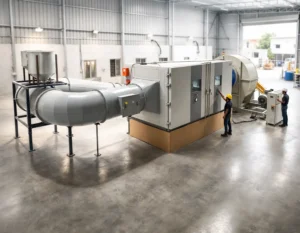
MIL-STD Sand & Dust Test Chambers
MIL-STD Sand and Dust Test Chambers MIL-STD Sand and Dust
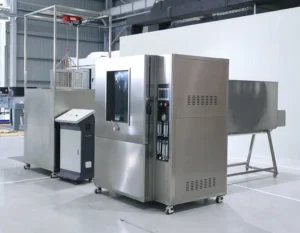
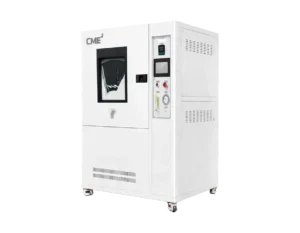
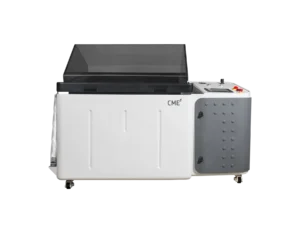
Salt Spray Test Chambers (SST)
Salt Spray Test Chambers (SST) Reliable Corrosion Testing Built on