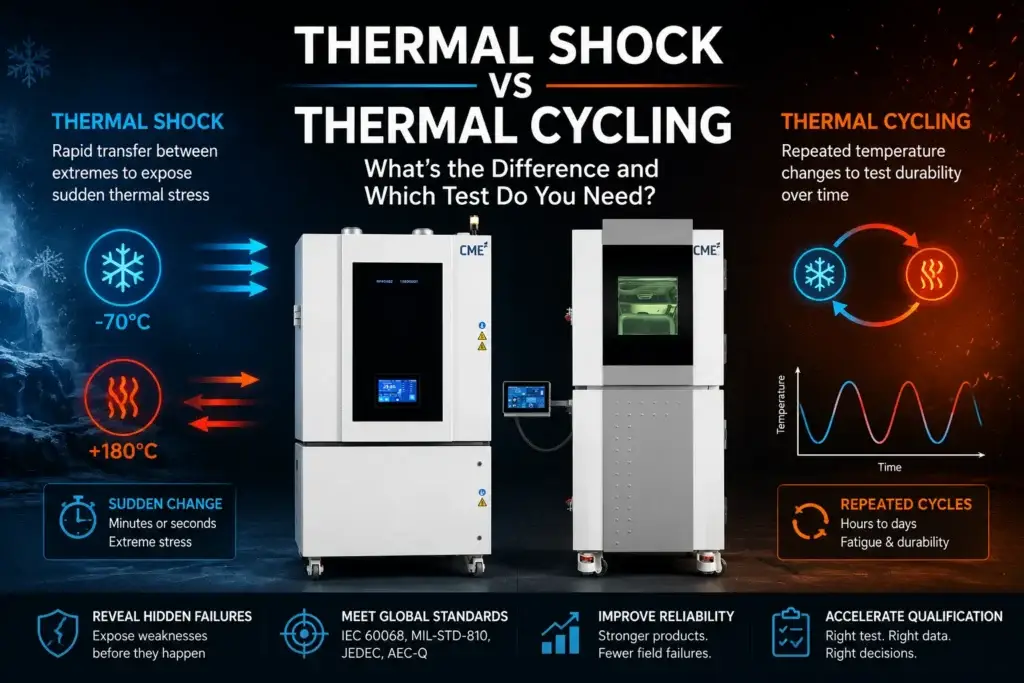
A product can survive hundreds of temperature cycles and still fail when subjected to one sufficiently rapid temperature transition. That is because thermal cycling and thermal shock are not the same test. Both expose a test specimen to high and low temperatures. But the rate at which the specimen experiences that temperature change can create very different stresses and reveal very different failure mechanisms. Understanding this distinction is important when selecting a test method, developing a qualification programme, or specifying an environmental test chamber.
Thermal cycling repeatedly exposes a product to controlled high and low temperatures, normally with defined ramp rates and dwell periods. Thermal shock exposes the product to a much more abrupt transition between hot and cold environments. The difference is not simply the temperature range. It is how quickly the temperature of the test specimen changes and the resulting thermal gradients inside it.
The correct test therefore depends on the failure mechanism you are trying to reproduce, not simply the highest and lowest temperatures required.
Thermal cycling exposes a product repeatedly to alternating high and low temperatures. A typical cycle consists of: Low-temperature dwell → controlled heating → high-temperature dwell → controlled cooling → repeat. The product normally remains stationary inside the chamber while the chamber air temperature changes according to the programmed profile. For example, a test profile could move between −40°C and +85°C over hundreds or even thousands of cycles. The actual temperatures, ramp rates, dwell periods and number of cycles must be determined by the applicable test standard and product requirements.
Materials expand when heated and contract when cooled. The challenge is that a product is rarely made from a single material. A typical electronic assembly may contain PCB laminates, copper tracks, solder joints, semiconductor packages, connectors, adhesives, plastics and aluminium or steel structures. Each material has a different coefficient of thermal expansion (CTE). Repeated temperature cycling therefore creates mechanical strain between materials and interfaces. One cycle may cause almost no visible damage. After hundreds or thousands of cycles, however, accumulated fatigue can expose weaknesses.
This makes thermal cycling particularly valuable when the objective is to understand repeated thermal fatigue over the expected life of a product.
What Is Thermal Shock Testing?
Thermal shock testing exposes a test specimen to a very rapid change between hot and cold temperature environments. A common air-to-air thermal shock system uses separate hot and cold zones maintained near their required temperatures. The specimen is transferred rapidly between these zones rather than waiting for a single chamber to heat or cool. A typical sequence is: Cold zone → rapid transfer → hot zone → rapid transfer → cold zone This rapid transition creates steep temperature gradients within the test specimen. The surface of a component may begin changing temperature significantly before its internal mass responds. Different materials and different areas of the assembly can therefore expand or contract at different rates. This transient differential is what creates thermal shock.
Consider a component with a metal housing bonded to a polymer component. During a slower temperature change, both materials have more time to approach thermal equilibrium. During an abrupt transition, the metal surface may respond much faster than the polymer or internal structure. For a short period, different parts of the assembly can therefore experience significantly different temperatures. The resulting dimensional mismatch creates mechanical stress at their interfaces. This is why thermal shock can expose defects that may remain hidden during conventional temperature cycling.
Thermal shock is particularly relevant when products may experience abrupt environmental or operational temperature transitions.
Chamber Temperature vs Product Temperature
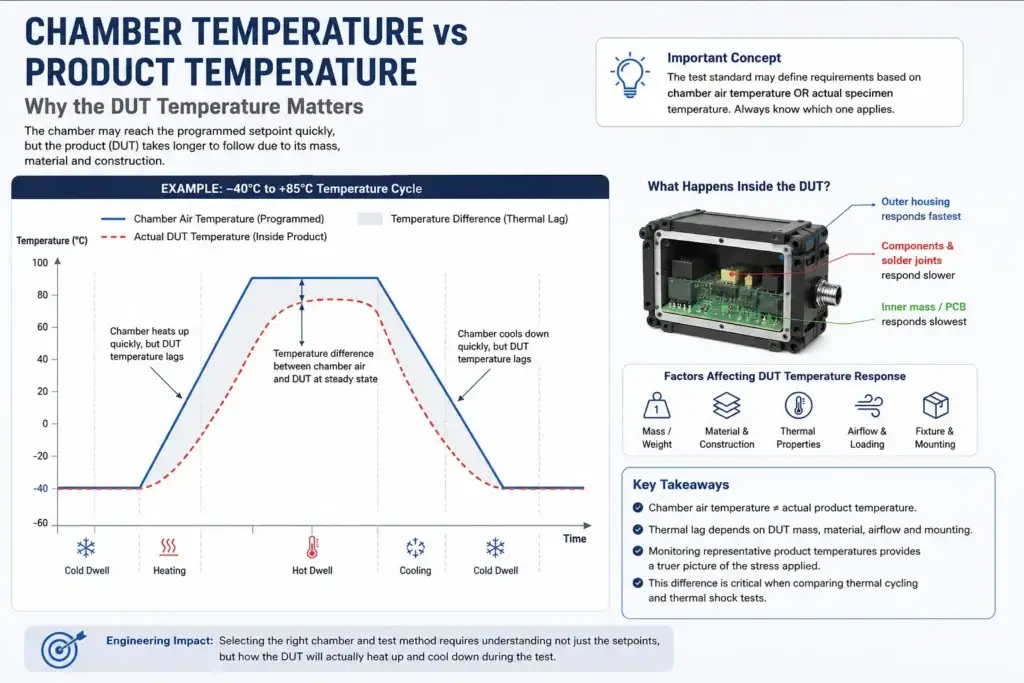
One of the most important concepts in environmental testing is often overlooked: the chamber air temperature is not necessarily the temperature of the test specimen. A chamber may reach its programmed temperature quickly, while the device under test (DUT) responds more slowly because of its thermal mass. The actual DUT temperature response depends on factors including:
This distinction becomes particularly important when comparing thermal cycling and thermal shock. Engineers should distinguish between chamber air temperature ramp rate and actual DUT temperature ramp rate. They are not necessarily the same. Monitoring representative product temperatures using appropriately positioned sensors can provide a more meaningful picture of the thermal stress actually being applied.
A common question is: “If an environmental chamber can change temperature very quickly, isn't that effectively thermal shock?” Not necessarily. A rapid temperature cycling chamber and a thermal shock chamber create the temperature transition differently. In a conventional temperature chamber, the refrigeration and heating systems must change the temperature of the chamber workspace and the DUT. In a thermal shock system, the hot and cold environments are already conditioned. The DUT is rapidly transferred from one environment to the other. This difference can create substantially different transient temperature gradients within the product.
The distinction becomes especially important when a qualification standard defines parameters such as: Transfer time Recovery time Dwell time Chamber temperature Specimen temperature Number of cycles The chamber should therefore be selected around the required test method and DUT response, rather than selecting a chamber first and adapting the test around its capabilities.
A thermal cycling test is typically performed in a single-zone temperature or environmental test chamber. The DUT remains inside the workspace while the chamber's refrigeration and heating systems move the temperature between programmed setpoints. This architecture provides flexibility for:
- Temperature cycling
- Controlled ramp-rate testing
- High- and low-temperature conditioning
- Temperature and humidity testing
- Long-duration reliability testing
- Automated multi-cycle test profiles
For demanding applications, the chamber must be sized not only for the required temperature range but also for the DUT thermal load, required rate of temperature change and recovery performance.
A thermal shock chamber is specifically designed to expose the DUT to rapid transitions between independently conditioned temperature environments. Rather than waiting for a single workspace to heat or cool, the DUT is transferred between zones that are already maintained near their required temperatures.
In a two-zone system, the specimen carrier moves directly between:
HOT ZONE ↕ COLD ZONE
This architecture enables rapid exposure to opposing temperature extremes while minimising transfer time.
A three-zone configuration can introduce an ambient zone in addition to the hot and cold conditions, depending on the required test method and chamber design. The appropriate configuration depends on the test standard, temperature range, DUT dimensions and weight, thermal load, transfer requirements and required cycle time.