Introduction
In summary, reach-in vs walk-in environmental test chambers serve different testing needs and choosing wisely is essential.
In environmental testing, the decision between a reach-in and a walk-in chamber is not merely about physical size. It directly impacts test accuracy, airflow dynamics, safety architecture, heat load management, scalability, compliance with international standards, and long-term operational efficiency. At CME, environmental test chamber selection is approached as a system engineering decision, not a catalog choice. This guide explains the engineering logic behind selecting reach-in vs walk-in environmental test chambers and provides practical criteria used in real-world automotive, EV battery, aerospace, defense, solar, and industrial validation programs.
When choosing between reach-in vs walk-in environmental test chambers, it’s essential to consider the testing requirements and overall project goals.
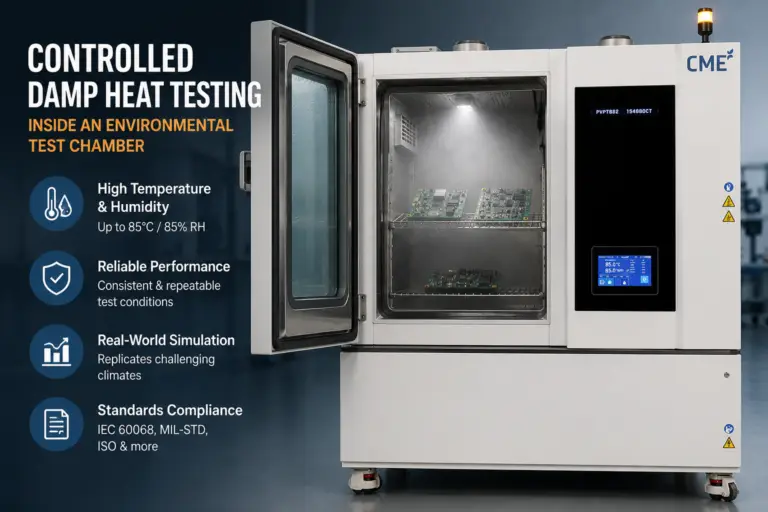
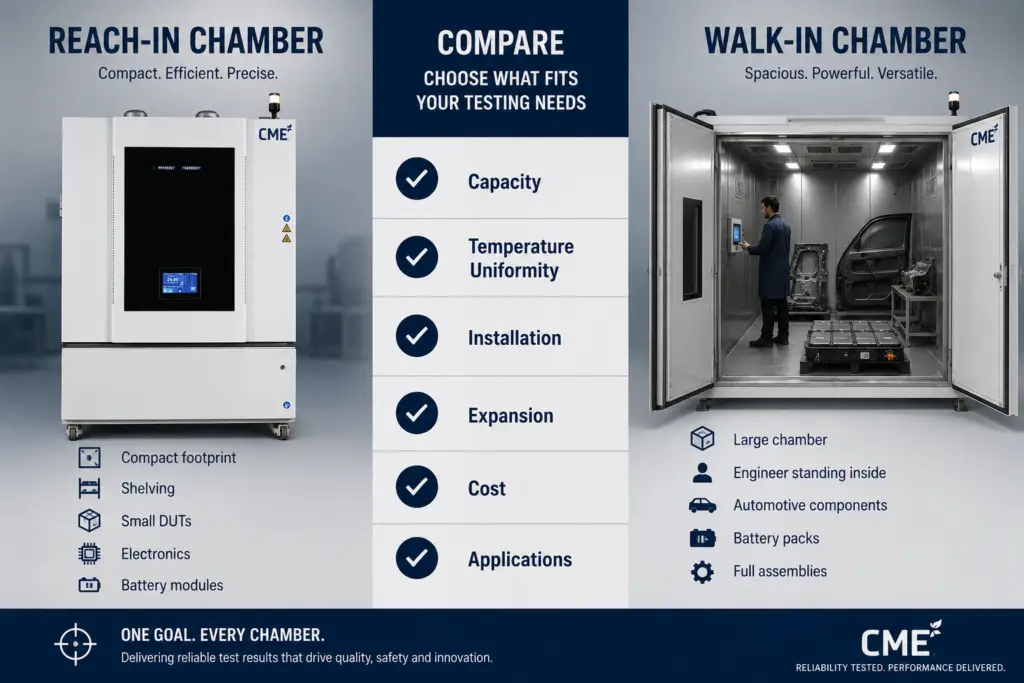
A reach-in environmental test chamber (also known as a climatic chamber or temperature humidity chamber) is a self-contained cabinet system designed for controlled temperature and humidity testing of components and subassemblies. These chambers are typically used in R&D laboratories, validation environments, electronics testing, material testing, and component-level automotive qualification.
CME reach-in chambers are engineered for precise temperature uniformity, optimized airflow, rapid ramp rates, and digital traceability through the enviCoM™ 4.0 controller.
A walk-in environmental test chamber is a room-sized system designed to accommodate large assemblies, full systems, battery packs, vehicles, or multiple test specimens simultaneously. Unlike reach-in units, walk-in chambers allow personnel access for installation, instrumentation, and monitoring.
CME walk-in chambers are custom-engineered to manage high heat loads, complex airflow distribution, structural reinforcement, safety zoning, and integration with high-voltage, mechanical, or combined stress systems.
Understanding the unique advantages of reach-in vs walk-in environmental test chambers can lead to better test results.
At a Glance:
| Column 1 | Column 2 |
|---|---|
| Reach-In | Walk-In |
| Compact | Large |
| Lower cost | Higher investment |
| Small DUTs | Large DUTs |
| Faster installation | Custom engineered |
| Standard models | Fully customised |
Primary Engineering Factors in Selection
Evaluating the differences of reach-in vs walk-in environmental test chambers is crucial for ensuring quality outcomes.
1. Payload Size and Volume
If the test object fits within a cabinet footprint and does not require personnel access during testing, a reach-in chamber is typically sufficient. Large assemblies, EV battery packs, power cabinets, or full vehicle subsystems generally require walk-in chambers.
The choice between reach-in vs walk-in environmental test chambers is crucial for various applications, including automotive and aerospace industries.
2. Heat Load and Thermal Mass
To maximize efficiency, companies must consider the pros and cons of reach-in vs walk-in environmental test chambers.
Battery packs, inverters, motors, and full systems generate significant internal heat. Walk-in chambers provide greater refrigeration capacity, airflow management, and heat extraction capability. Improper heat load assessment can compromise temperature stability and test validity.
For optimal performance, selecting the right type of chamber, be it reach-in vs walk-in environmental test chambers, significantly affects test outcomes.
3. Airflow Uniformity
Each project’s demands can shed light on whether reach-in vs walk-in environmental test chambers are more suitable.
Uniformity requirements defined under IEC 60068, ISO 16750, and automotive OEM standards demand controlled airflow. Walk-in chambers require engineered ducting and distribution systems to maintain uniformity across larger volumes.
4. Standards and Compliance Requirements
Certain standards—such as ISO 16750 (automotive), IEC 62660 (battery), IEC 61215 (solar), and MIL-STD-810—may require full-system testing or large test volumes that only walk-in chambers can accommodate.
Understanding the differences between reach-in vs walk-in environmental test chambers can enhance testing protocols.
5. Safety Architecture
For EV battery testing, high-voltage systems, or defense applications, walk-in chambers often integrate gas exhaust systems, pressure relief panels, fire detection interfaces, and safety zoning. Reach-in chambers are suitable for lower-risk component testing but may not support large-scale hazard mitigation.
When comparing reach-in vs walk-in environmental test chambers, assessing the scale of testing is vital.
Operational and Infrastructure Considerations
Evaluating reach-in vs walk-in environmental test chambers helps in making informed decisions that affect overall project efficiency.
Reach-in chambers require minimal infrastructure, occupy limited floor space, and are easier to deploy in laboratory environments. Walk-in chambers require power planning, reinforced flooring, ventilation integration, and detailed installation planning. However, they provide superior scalability and throughput for high-volume programs.
Scalability and Future Expansion
In many cases, the decision of reach-in vs walk-in environmental test chambers can dictate the success of testing projects.
Organizations transitioning from component validation to full-system testing often outgrow reach-in chambers. Selecting a walk-in system early can prevent redundant capital expenditure and enable future integration with vibration systems (AGREE), solar simulation, or mechanical testing setups.
Both reach-in and walk-in CME chambers are powered by enviCoM™ 4.0, enabling multi-segment ramp/soak profiles, secure data logging, alarm traceability, and remote diagnostics through Levito digital services. Data integrity is critical for audits, certification, and regulatory submissions.
Ultimately, the decision of reach-in vs walk-in environmental test chambers will depend on specific testing criteria.
Cost vs Lifecycle Value
While reach-in chambers offer lower initial capital investment, lifecycle cost should account for scalability, throughput, and long-term program requirements. A well-engineered walk-in chamber may provide greater long-term value for automotive, EV, aerospace, or industrial qualification programs.
Decision Matrix
Many customers inquire about reach-in vs walk-in environmental test chambers when assessing their testing capabilities.
| Table Content | |
|---|---|
| If you need… | Choose… |
| PCB testing | Reach-In |
| Battery modules | Reach-In |
| Battery packs | Walk-In |
| Automotive assemblies | Walk-In |
| Solar panels | Walk-In |
| High throughput | Walk-In |
| R&D laboratory | Reach-In |
| Production validation | Walk-In |
Conclusion: Engineering-Led Selection
The selection between reach-in and walk-in environmental test chambers should be based on payload characteristics, heat load, safety requirements, applicable standards, and long-term scalability. At CME, chamber configuration is treated as an integrated engineering solution rather than a catalog decision. For organizations evaluating environmental testing infrastructure, consulting with experienced CME engineers ensures alignment with international standards, operational efficiency, and future program expansion.
When considering the nuances of reach-in vs walk-in environmental test chambers, it is essential to weigh all factors carefully.
Looking for a Reach-In Environmental Test Chamber?
Explore CME’s complete range of Reach-In Environmental Test Chambers →Looking for a Walk-In Environmental Test Chamber?
Explore CME’s complete range of Walk-In Environmental Test Chambers →
Many organizations face the challenge of selecting reach-in vs walk-in environmental test chambers for their specific testing needs.
Continue Learning
Understanding the applications for reach-in vs walk-in environmental test chambers can streamline the selection process.
The industry often discusses reach-in vs walk-in environmental test chambers to determine best practices in testing.