Introduction
Environmental testing evaluates how products perform when exposed to controlled temperature, humidity, vibration, UV radiation, altitude, dust, corrosion, and other environmental stresses. By recreating real-world operating conditions inside specialised environmental test chambers, engineers can identify weaknesses before products reach customers or critical installations.
Whether developing automotive components, aerospace electronics, medical devices, batteries, industrial equipment, or renewable energy products, environmental testing is essential for ensuring long-term reliability, regulatory compliance, and product safety.
This guide explains how environmental testing works, the different types of environmental tests, and how modern environmental chambers help manufacturers validate products before deployment.
What Is Environmental Testing?
Environmental testing is the process of exposing products to controlled environmental conditions that simulate the stresses experienced during transportation, storage, installation, and operation.
Instead of waiting months or years for natural degradation, manufacturers accelerate environmental conditions inside test chambers to observe failures, verify design margins, and improve reliability.
Typical environmental variables include:
- Temperature
- Humidity
- Thermal cycling
- UV radiation
- Altitude
- Dust and sand
- Salt spray
- Rain
- Vibration
- Combined environmental stresses
Environmental testing is widely used for qualification, product development, failure analysis, and compliance with international standards.
Why Is Environmental Testing Important?
Environmental failures can result in costly recalls, warranty claims, production downtime, or safety incidents.
Environmental testing helps manufacturers:
- Identify weak product designs before production
- Improve long-term reliability
- Reduce warranty costs
- Validate design changes
- Meet customer qualification requirements
- Demonstrate compliance with IEC, MIL, ISO and automotive standards
- Accelerate product development cycles
Testing products under controlled conditions provides valuable engineering data that cannot be obtained through normal field operation.
How Does Environmental Testing Work?
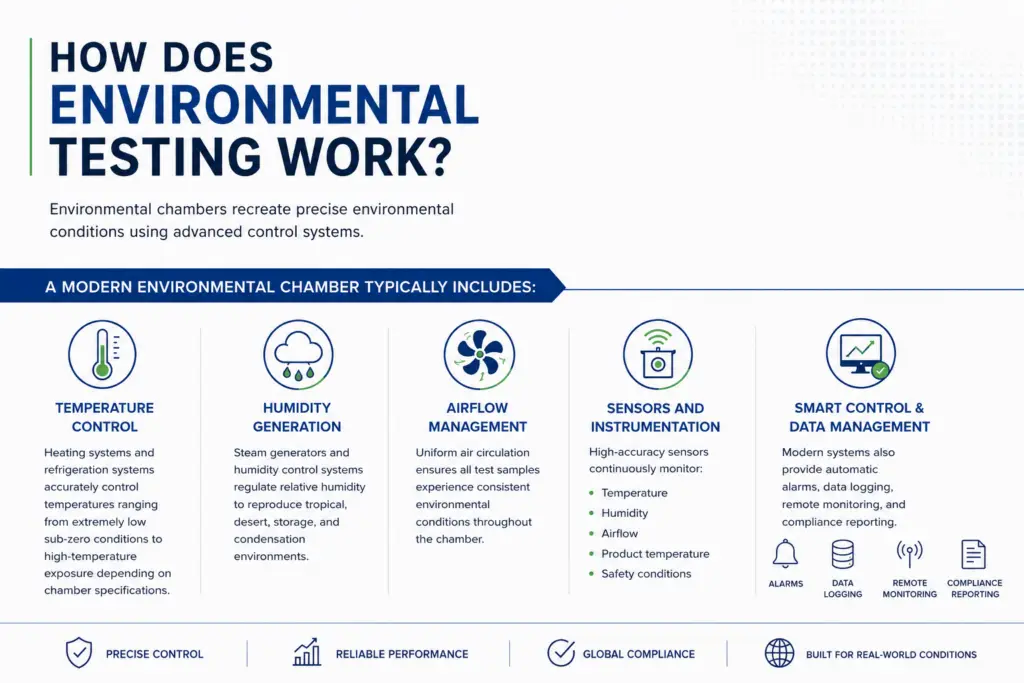
Environmental chambers recreate precise environmental conditions using advanced control systems.
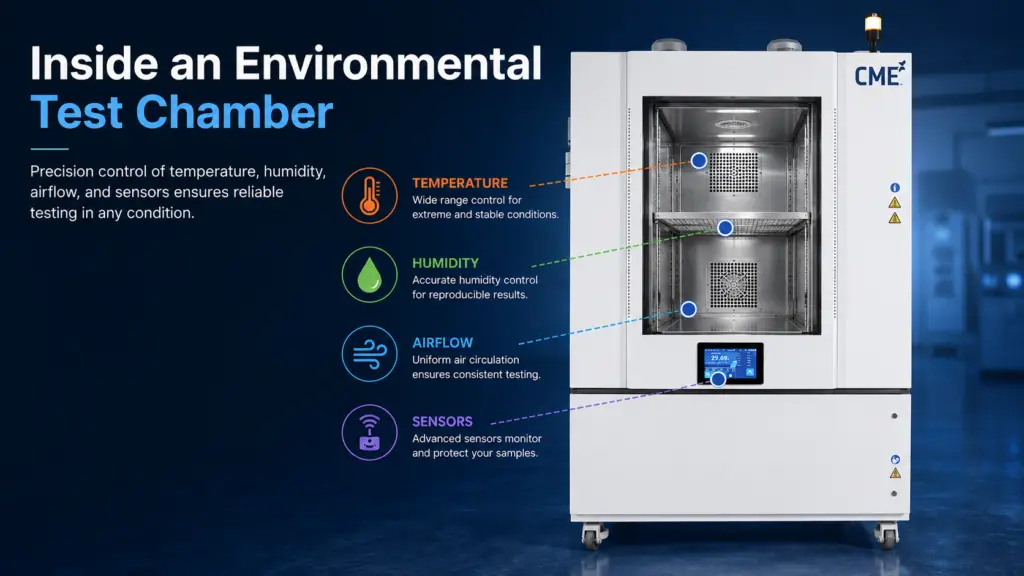
A modern environmental chamber typically includes:
Temperature Control
Heating systems and refrigeration systems accurately control temperatures ranging from extremely low sub-zero conditions to high-temperature exposure depending on chamber specifications.
Humidity Generation
Steam generators and humidity control systems regulate relative humidity to reproduce tropical, desert, storage, and condensation environments.
Airflow Management
Uniform air circulation ensures all test samples experience consistent environmental conditions throughout the chamber.
Sensors and Instrumentation
High-accuracy sensors continuously monitor:
- Temperature
- Humidity
- Airflow
- Product temperature
- Safety conditions
Modern systems also provide automatic alarms, data logging, remote monitoring, and compliance reporting.
Types of Environmental Testing
Manufacturers perform different environmental tests depending on product application.
Temperature Testing
Products are exposed to high and low temperatures to evaluate material behaviour, electronics performance, dimensional stability, and operational functionality.
Applications include:
- Electronics
- Automotive components
- Aerospace equipment
- Industrial machinery
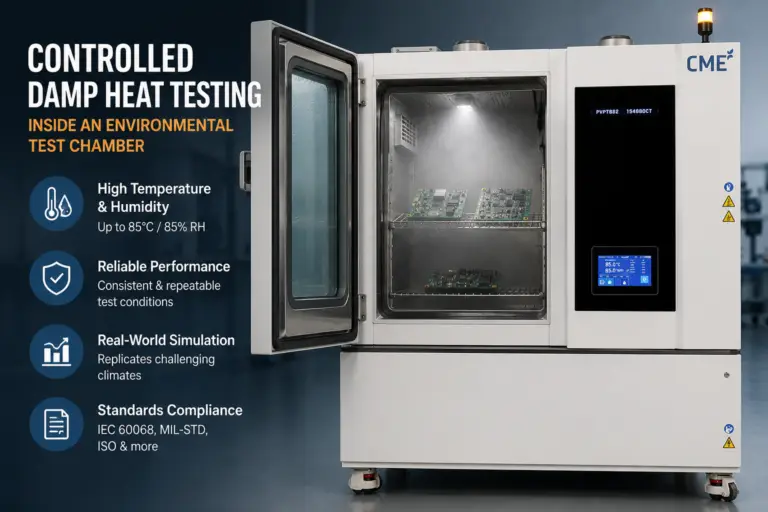
Humidity Testing
Humidity testing evaluates how moisture affects products over time.
Typical concerns include:
- Corrosion
- Moisture ingress
- Seal degradation
- Insulation failure
- PCB reliability
Common standards include IEC 60068 damp heat testing.
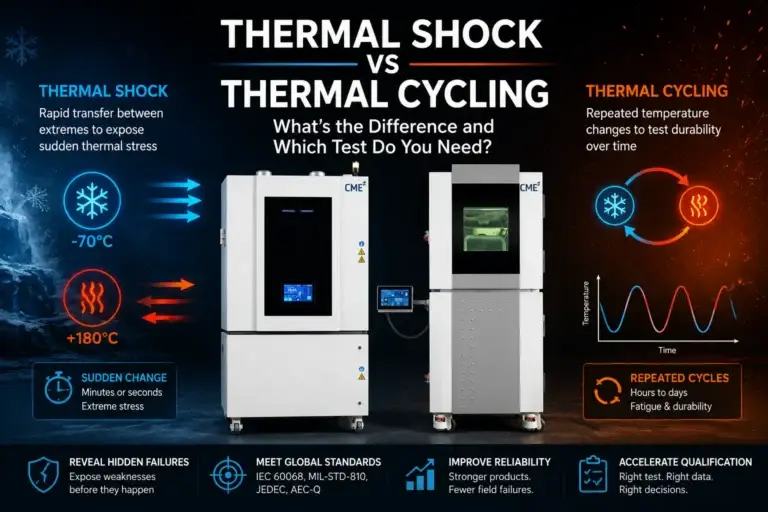
Thermal Cycling
Thermal cycling repeatedly changes temperature between hot and cold conditions.
The test evaluates:
- Expansion and contraction
- Material fatigue
- Joint reliability
- Solder performance
- Seal integrity
UV Weathering
UV testing reproduces long-term sunlight exposure using artificial ultraviolet radiation.
It evaluates:
- Colour fading
- Polymer degradation
- Surface cracking
- Material ageing
Widely used for:
- Plastics
- Automotive exteriors
- Solar products
- Outdoor electronics
Altitude Testing
Reduced pressure simulates high-altitude environments experienced during aircraft transport or mountain operation.
Typical applications include:
- Aerospace
- Defence
- Aviation electronics
- Medical devices
Combined Environmental Testing
Modern environmental chambers can combine multiple stresses including:
- Temperature
- Humidity
- Vibration
- Solar radiation
- Electrical loading
Combined testing provides a much more realistic simulation of actual field conditions.
Industries That Use Environmental Testing
Environmental testing is critical across numerous industries.
Automotive
- EV battery validation
- Brake testing
- Power electronics
- Sensors
- Interior components
Aerospace & Defence
- Avionics
- Radar systems
- Military electronics
- Flight-qualified hardware
Electronics
- PCB reliability
- Consumer electronics
- Industrial controllers
- Semiconductor devices
Renewable Energy
- Solar PV modules
- Wind turbine electronics
- Energy storage systems
Medical Devices
- Diagnostic equipment
- Laboratory instruments
- Healthcare electronics
Industrial Equipment
- Automation systems
- Electrical switchgear
- Control panels
- Process instrumentation
Common Environmental Testing Standards
Manufacturers often perform testing according to internationally recognised standards.
Some of the most common include:
- IEC 60068 Environmental Testing
- IEC 61215 Solar PV Qualification
- ISO 16750 Road Vehicles
- MIL-STD-810 Environmental Engineering
- ASTM Environmental Testing Standards
- JEDEC Semiconductor Reliability Standards
The exact standard depends on product type and industry.
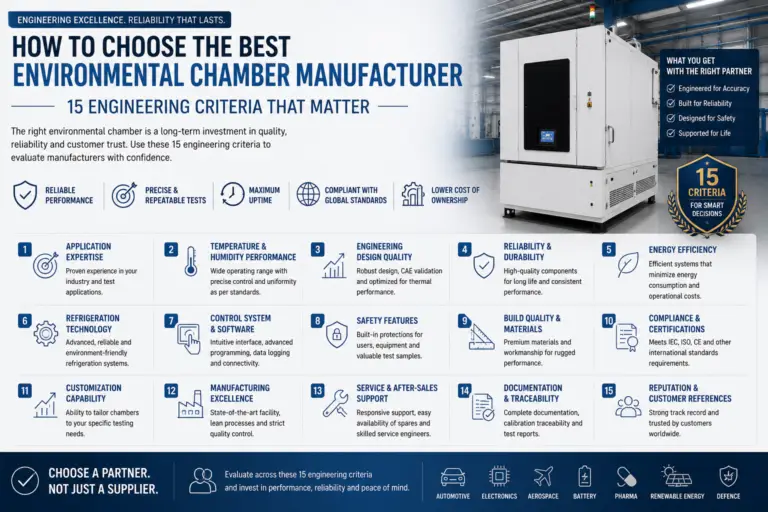
Choosing the Right Environmental Test Chamber
Selecting the correct environmental chamber depends on:
- Temperature range
- Humidity range
- Internal workspace
- Sample size
- Heating and cooling rates
- Uniformity requirements
- Automation requirements
- Data logging
- Future testing needs
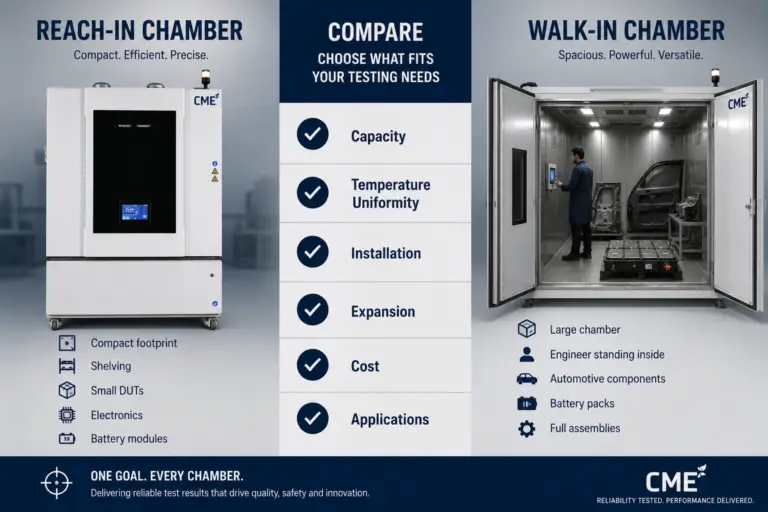
Common chamber types include:
- Benchtop Chambers
- Reach-In Chambers
- Walk-In Chambers
- Drive-In Chambers
- Custom Environmental Simulation Systems
Future Trends in Environmental Testing
Environmental testing continues to evolve through:
- IoT-enabled chambers
- Remote monitoring
- Automated test reporting
- Predictive maintenance
- AI-assisted diagnostics
- Cloud-based data storage
- Industry 4.0 integration
These technologies reduce manual intervention while improving repeatability and traceability.
Conclusion
Environmental testing allows manufacturers to validate product performance before products enter real-world service. By accurately simulating temperature, humidity, UV exposure, thermal cycling, and other environmental stresses, environmental chambers help improve reliability, reduce failures, and accelerate product development.
As products become increasingly complex and quality expectations continue to rise, environmental testing remains one of the most valuable tools available for engineering validation and regulatory compliance.
Frequently Asked Questions
What is environmental testing?
Environmental testing evaluates how products perform under controlled environmental conditions such as temperature, humidity, vibration, UV exposure, and altitude.
Why is environmental testing important?
It identifies potential failures before products reach customers, improving reliability while reducing warranty costs and field failures.
What industries use environmental testing?
Automotive, aerospace, defence, electronics, renewable energy, pharmaceuticals, medical devices, and industrial manufacturing.
What is an environmental test chamber?
An environmental test chamber is specialised equipment that recreates controlled environmental conditions for product qualification and reliability testing.
What standards are commonly used?
IEC 60068, IEC 61215, MIL-STD-810, ISO 16750, ASTM, and JEDEC standards are among the most widely used.