Overview
CM Envirosystems engineered and commissioned a high-precision Brake NVH Dyno Cooling Unit designed specifically for automotive brake and friction material testing laboratories.
The system conditions the environmental air supplied to a brake dynamometer test cell, enabling precise control of temperature, relative humidity, and air velocity required for standardized brake performance testing.
The installation supports environmental conditioning requirements defined under SAE J2521, a widely used standard for brake dynamometer testing of friction materials under controlled climatic conditions.
Following installation, the system underwent full Factory Acceptance Testing (FAT) and Acceptance Test Procedures (ATP) to verify compliance with the required environmental performance specifications.
All test profiles were successfully completed and the system was commissioned for operational use.

Application
Brake and friction material testing requires controlled environmental conditions to ensure repeatability and comparability of dynamometer test results.
Environmental parameters such as temperature, humidity, and airflow over the brake assembly directly influence:
- Friction coefficient
- Pad and rotor wear
- Brake noise (NVH)
- Fade and recovery behaviour
- Corrosion and moisture effects
To ensure consistency across test programs, standards such as SAE J2521 require that brake components be conditioned within tightly controlled climatic environments before and during testing.
The CME Brake NVH Dyno Cooling Unit was developed to provide these controlled conditions to the brake dynamometer test cell.
System Description
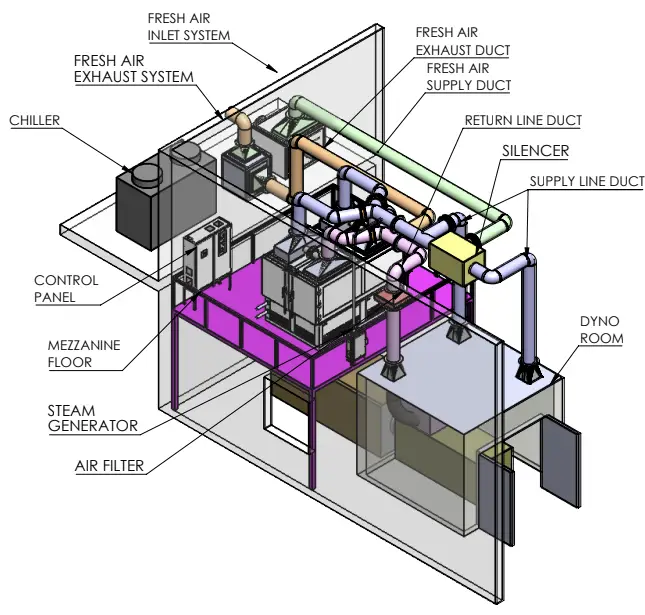
The installed system consists of a high-capacity Brake NVH Dyno Cooling Unit connected to the brake test facility through insulated ducting.
The RCU generates conditioned airflow which is supplied directly to the brake dynamometer enclosure, ensuring stable environmental conditions around the brake assembly.
System Specifications
Product: Brake NVH Dyno Cooling Unit
Model: RCUB1416HCAPAA60KMH6DEFAC
Environmental Control Parameters
Temperature range validated during ATP
- −15°C to +22°C
Relative Humidity Range
- 30% RH to 60% RH
Air Velocity at Test Cell
- 35 km/h controlled airflow
Control Accuracy Requirements
- Temperature stability: ±1°C
- Humidity stability: ±5% RH
- Air velocity tolerance: ±2 km/h
These parameters allow the system to replicate environmental conditions required for brake testing across multiple climatic scenarios.
Environmental Test Capability
The conditioning system supports several SAE J2521 environmental profiles used for brake and friction material testing.
Example validated conditions include:
| Column 1 | Column 2 | |||
|---|---|---|---|---|
Test Condition | Temperature | Humidity | Air Velocity | Soak Duration |
Standard conditioning | +20°C | 50% RH | 35 km/h | 12 hours |
Dry climate conditioning | +10°C | 30% RH | 35 km/h | 12 hours |
Cold environment conditioning | −5°C | 30% RH | 35 km/h | 12 hours |
High humidity condition | +22°C | 60% RH | 35 km/h | 14 hours |
Cold & humid condition | −15°C | 50% RH | 35 km/h | 13–24 hours |
These profiles replicate environmental conditions encountered by braking systems in different operating climates.
Acceptance Test Performance
Performance verification was carried out through multiple ATP environmental conditioning cycles.
The tests measured stability of:
- Temperature
- Relative humidity
- Air velocity
over extended soak periods.
Example Performance Verification
Test Condition
- Temperature Setpoint: +11°C
- Relative Humidity: 35% RH
- Air Velocity: 35 km/h
- Soak Duration: 1 hour
Measured Results
Temperature
- Minimum: 10.1°C
- Maximum: 11.8°C
Humidity
- Minimum: 30% RH
- Maximum: 36% RH
Air Velocity
- Minimum: 33.8 km/h
- Maximum: 35.9 km/h
The measured fluctuations remained within the required tolerances of:
- ±1°C temperature
- ±5% RH humidity
- ±2 km/h air velocity
during the soak period.
Cold Environmental Conditioning Test
Another validation test simulated cold climate conditioning prior to brake testing.
Test Condition
- Temperature: −15°C
- Relative Humidity: 50% RH
- Air Velocity: 35 km/h
- Soak Duration: 13 hours
Measured Performance
- Temperature: −15.5°C to −14.3°C
- Humidity: 49% to 53% RH
- Air Velocity: 33 km/h to 35.4 km/h
All parameters remained within the specified tolerances.
Stability During Extended Conditioning
Extended environmental conditioning tests were conducted to ensure stable operation over long soak durations required for brake dynamometer testing.
For example, during SAE J2521 environmental conditioning:
- Temperature fluctuation remained between 19.8°C and 20.7°C
- Humidity fluctuation remained between 50% and 51% RH
- Air velocity remained between 32.1 km/h and 37.2 km/h
over a soak duration exceeding 11 hours.
This level of stability ensures reliable environmental conditioning prior to brake dynamometer test cycles.
System Performance Summary
Across all FAT and ATP validation tests, the Remote Conditioning Unit demonstrated:
- Precise control of environmental conditions
- Stable performance over long soak durations
- Compliance with SAE J2521 environmental conditioning requirements
- Reliable airflow delivery to the brake test cell
All tests were completed successfully and the system was released for operational use.
Outcome
The installation provides the brake testing facility with a reliable environmental conditioning system for friction material and brake dynamometer testing.
The system enables repeatable testing under controlled climatic conditions, ensuring that brake performance evaluations accurately reflect environmental influences encountered in real-world vehicle operation.
Why a Brake NVH Dyno Cooling Unit instead of a Chamber?
A traditional environmental chamber encloses the specimen.
- Conditions the air externally
- Delivers it through insulated ductwork
- Supports large or fixed test rigs
- Enables integration with dynamometers
- Allows easier maintenance and future expansion
Looking for a Custom Environmental Conditioning Solution?
Whether you are integrating environmental control with a brake dynamometer, engine test cell, battery test rig, or another specialised validation system, CME engineers custom solutions tailored to your application, test standards, and laboratory constraints.
Explore Related Resources
- Brake NVH Testing Explained
- Remote Conditioning Units
- Air Stream Units
- Combined Environmental & Mechanical Test Systems
- Contact CME Engineering
External Links
- SAE International (Brake testing standards and automotive engineering)
https://www.sae.org - ISO Standards (General automotive testing standards)
https://www.iso.org - International Electrotechnical Commission (IEC) (Environmental testing principles)
https://www.iec.ch - ASTM International (Material testing standards)
https://www.astm.org