Introduction
A product that performs perfectly in the laboratory may still fail after months in tropical field conditions. Moisture ingress, corrosion, insulation degradation and material delamination often develop slowly and remain invisible during conventional testing. Damp heat testing accelerates these ageing mechanisms inside a controlled laboratory environment, allowing engineers to identify long-term reliability risks before products reach customers.
Damp Heat Testing at a Glance
- Test Conditions: 85°C / 85% RH
- Typical Duration: 1,000 hours (IEC 61215)
- Primary Failure Mechanisms: Corrosion, moisture ingress, delamination, insulation degradation
- Common Industries: Solar PV, EV batteries, electronics, aerospace, automotive
- Key Standards: IEC 60068-2-78, IEC 61215, IEC 61730
What is Damp Heat Testing?
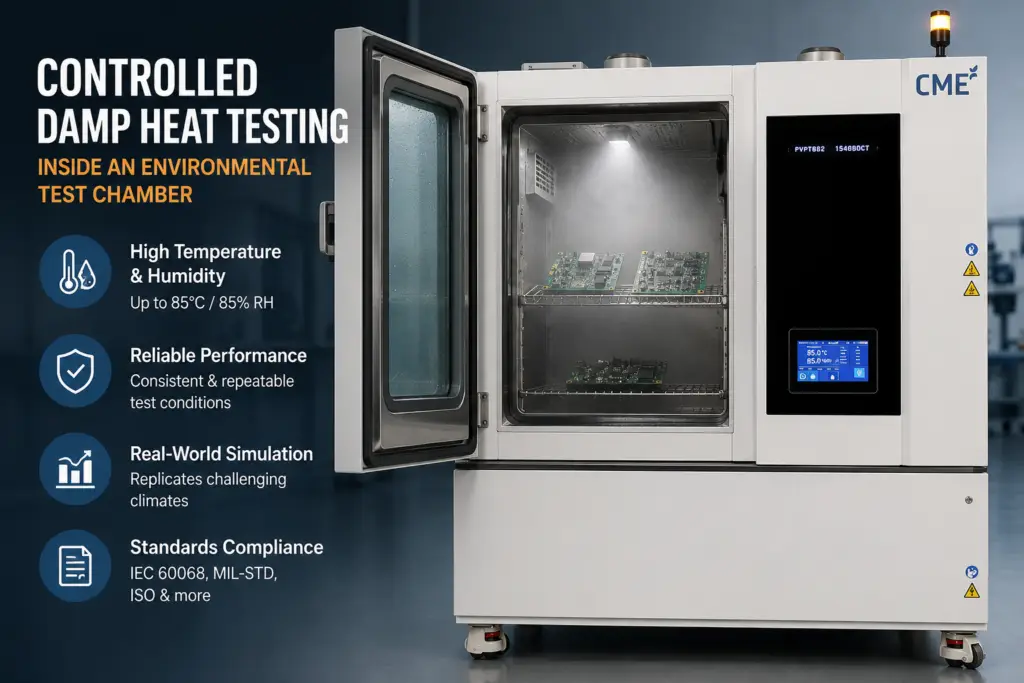
Damp heat testing is a controlled environmental test performed at elevated temperature and relative humidity for extended periods—commonly 85°C and 85% RH for durations ranging from 240 hours to 1000+ hours depending on applicable standards.
The purpose is to accelerate moisture ingress, corrosion processes, polymer degradation, and insulation breakdown to simulate long-term field exposure.
Why Damp Heat is Critical for Reliability
1. Moisture Ingress and Seal Integrity
High humidity combined with temperature accelerates diffusion of moisture through gaskets, potting materials, encapsulants, and enclosure interfaces. Damp heat testing reveals weaknesses in sealing architecture that may not appear during short-term testing.
2. Corrosion Acceleration
Sustained humidity promotes electrochemical corrosion in connectors, busbars, terminals, and metallic coatings. This is particularly critical for automotive electronics, battery systems, and outdoor equipment.
3. Insulation Resistance Degradation
In high-voltage systems and EV battery assemblies, moisture can reduce insulation resistance, leading to leakage currents or safety risks. Damp heat testing validates insulation robustness under worst-case environmental exposure.
4. PV Module Qualification (IEC 61215)
For solar modules, damp heat testing under IEC 61215 is one of the most stringent reliability tests. Modules are typically exposed to 85°C / 85% RH for 1000 hours to evaluate encapsulant stability, interconnect corrosion, delamination risk, and long-term performance degradation.
Common Failures Revealed by Damp Heat Testing
- Corrosion of electrical contacts
- Moisture ingress
- PCB insulation failure
- Delamination
- Adhesive degradation
- Seal failures
- Connector oxidation
- Reduced insulation resistance
- Power degradation (PV)
Standards That Require Damp Heat Testing
Damp heat testing is defined or referenced under several international standards, including:
– IEC 60068-2-78 (Environmental testing – Damp heat steady state)
– IEC 61215 (PV module qualification)
– ISO 16750 (Automotive environmental conditions)
– IEC 62660 (Battery testing)
– Various OEM and defense qualification standards
Compliance with these standards requires precise humidity control, temperature stability, and uniform airflow distribution.
Engineering Challenges in Damp Heat Chambers
Maintaining stable 85°C / 85% RH conditions for extended durations presents engineering challenges including:
– Condensation management
– Uniform humidity distribution
– Corrosion-resistant internal construction
– Long-duration system reliability
CME damp heat chambers are engineered with optimized airflow design, corrosion-resistant interiors, precise humidity generation systems, and digital control through enviCoM™ 4.0 to ensure accurate long-duration performance.
Why Damp Heat is Not Just Another Climatic Test
Unlike cyclic humidity or short ramp/soak tests, damp heat is a sustained stress condition that exposes material weaknesses over time. It simulates tropical climates, coastal exposure, and enclosed high-humidity environments where products may operate for years.
Which Industries Use Damp Heat Testing?
- Solar PV Modules
- EV Battery Systems
- Automotive ECUs
- Aerospace Electronics
- Defence Systems
- Medical Devices
- Consumer Electronics
- Power Electronics
Digital Traceability and Data Integrity
For certification and audit purposes, damp heat testing requires reliable data logging and alarm tracking. CME systems powered by enviCoM™ 4.0 provide secure data storage, profile control, and remote monitoring via Levito digital services, ensuring traceability throughout extended test cycles.
Comparison Table:
| Column 1 | Column 2 | |
|---|---|---|
| Test | Purpose | Standard |
| Damp Heat | Moisture ageing | IEC 60068-2-78 |
| Thermal Cycling | Expansion fatigue | IEC 60068-2-14 |
| Humidity Freeze | Freeze resistance | IEC 61215 |
| UV Preconditioning | Sunlight ageing | IEC 61215 |
Conclusion
Damp heat testing is essential for validating long-term durability in high humidity environments. From PV modules to EV batteries and automotive electronics, it plays a decisive role in ensuring product reliability, safety, and compliance with global standards.
Selecting a well-engineered damp heat chamber with precise humidity control, corrosion-resistant construction, and digital traceability ensures accurate and repeatable long-duration qualification testing.