Introduction
Selecting an environmental chamber is a long-term investment that influences product quality, testing accuracy, development timelines and laboratory efficiency for years to come. While chamber specifications such as temperature range and humidity capability are important, the manufacturer behind the equipment often determines whether the system delivers reliable performance throughout its lifetime.
Environmental chambers are used to qualify products for industries including automotive, aerospace, defence, electronics, pharmaceuticals, renewable energy, medical devices and research laboratories. These applications demand precise environmental control, repeatable performance and compliance with internationally recognised testing standards.
Choosing the right manufacturer is therefore about much more than comparing brochures or obtaining the lowest quotation. It requires evaluating engineering expertise, design capability, long-term support and the ability to deliver solutions tailored to your application.
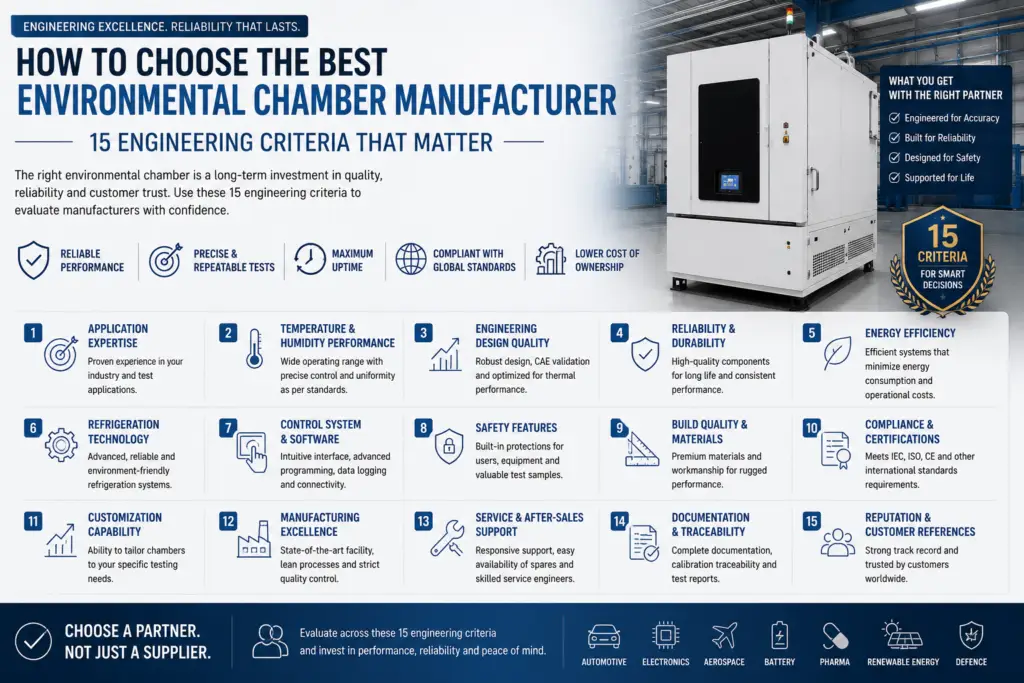
This guide explains the fifteen engineering criteria every buyer should consider before selecting an environmental chamber manufacturer.
Why the Manufacturer Matters
A well-designed environmental chamber should provide reliable temperature and humidity control over many years of continuous operation. Poor airflow design, undersized refrigeration systems or inadequate controls can result in inconsistent test conditions, increased downtime and higher operating costs.
An experienced manufacturer contributes value through:
- Better engineering
- Application expertise
- Higher reliability
- Faster service support
- Future scalability
- Compliance with international standards
The goal is not simply to purchase a chamber—it is to invest in reliable testing infrastructure that supports product development throughout its lifecycle.
1. Engineering Experience
Manufacturers with extensive experience across multiple industries understand that every testing application is different.
Look for companies capable of designing solutions for:
- Electronics
- Automotive
- Aerospace
- Defence
- Battery testing
- Solar energy
- Medical devices
- Industrial equipment
Experience with custom projects often indicates stronger engineering capability than a catalogue of standard products alone.
2. Compliance with International Standards
A chamber should be capable of supporting recognised environmental testing standards.
Examples include:
Manufacturers should understand not only the chamber specifications but also how these standards are implemented in practice.
3. Product Range
A broad product portfolio generally reflects stronger engineering capability.
An experienced manufacturer should be able to provide:
- Benchtop chambers
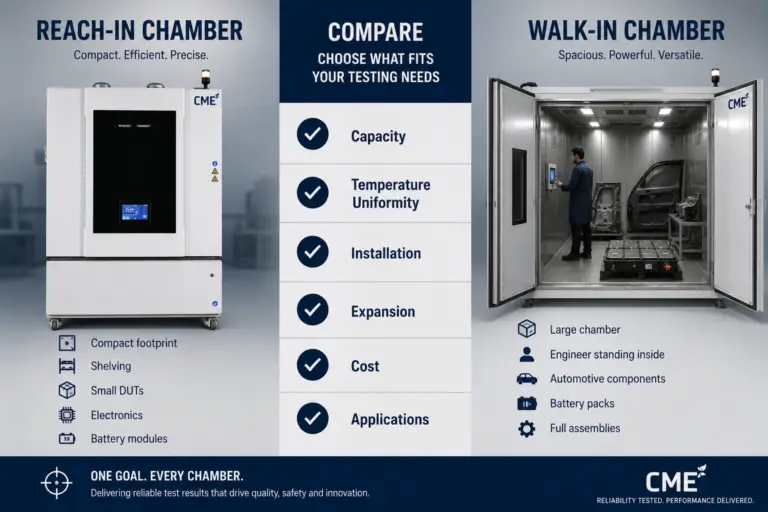
- Reach-in chambers
- Walk-in chambers
- Drive-in chambers
- Battery test chambers
- Thermal shock chambers
- Altitude chambers
- Corrosion chambers
- Solar simulation systems
- Custom environmental conditioning systems
This ensures your testing infrastructure can evolve alongside your organisation.
4. Custom Engineering Capability
Few laboratories have identical testing requirements.
Consider whether the manufacturer can customise:
- Chamber dimensions
- Temperature ranges
- Humidity systems
- Feedthroughs
- Automation
- Safety systems
- Airflow configuration
- Refrigeration systems
Customisation often reduces compromises and improves long-term usability.
5. Temperature Uniformity
One of the most overlooked specifications is temperature uniformity.
Maintaining ±1°C average chamber temperature is meaningless if different parts of the working volume experience significantly different conditions.
Good airflow engineering is just as important as refrigeration capacity.
6. Humidity Performance
Humidity control requires considerably more engineering than simply generating moisture.
Evaluate:
- RH stability
- RH uniformity
- Dew point control
- Condensation management
- Low humidity performance
- High humidity performance
Stable humidity improves repeatability and confidence in qualification testing.
7. Controller and Automation
Modern environmental chambers should provide:
- PLC-based control
- Touchscreen HMI
- Recipe management
- Data logging
- Ethernet connectivity
- Remote monitoring
- Alarm management
- User access control
Automation improves efficiency while reducing operator error.
8. Refrigeration Design
The refrigeration system is the heart of every environmental chamber.
Consider:
- Cascade refrigeration
- Energy efficiency
- Compressor selection
- Refrigerant choice
- Ease of maintenance
- Spare part availability
Well-designed refrigeration systems improve both performance and operating costs.
9. Safety Systems
Certain applications require specialised protection.
Examples include:
- Battery testing
- Flammable materials
- High-energy devices
- Chemical testing
Look for:
- Emergency shutdown
- Gas detection
- Pressure relief
- Fire suppression compatibility
- Safety interlocks
- Explosion protection where applicable
10. Calibration and Validation
Reliable qualification testing depends upon accurate measurement.
Manufacturers should support:
- Sensor calibration
- Uniformity mapping
- Factory Acceptance Testing (FAT)
- Site Acceptance Testing (SAT)
- Documentation
11. Installation and Commissioning
Large environmental chambers often require:
- Site surveys
- Utility planning
- Installation supervision
- Operator training
- Performance verification
Comprehensive commissioning reduces project risk.
12. Service and Spare Parts
Evaluate:
- Local service engineers
- Remote diagnostics
- Spare part availability
- Preventive maintenance programmes
- Response times
Reliable after-sales support often determines the true cost of ownership.
13. Energy Efficiency
Environmental chambers frequently operate continuously.
Energy-efficient design can significantly reduce operating costs through:
- Variable-speed compressors
- Improved insulation
- Intelligent control algorithms
- Efficient airflow management
- Modern refrigerants
14. Future Expansion
Laboratories rarely become smaller.
Consider whether the manufacturer can support future expansion through:
- Additional chambers
- Modular systems
- Larger walk-in facilities
- Battery testing infrastructure
- Integrated laboratory automation
Scalable infrastructure protects long-term investment.
15. Proven Project Experience
One of the strongest indicators of engineering capability is a portfolio of completed projects.
Look for manufacturers with experience in:
- Walk-in chambers
- Drive-in vehicle chambers
- Battery testing chambers
- Remote conditioning units
- Brake dynamometer conditioning
- Solar simulation chambers
Case studies demonstrate practical engineering experience beyond catalogue specifications.
Comparison Checklist
| Evaluation Criteria | Why It Matters |
|---|---|
| Engineering experience | Better application knowledge |
| International standards | Reliable qualification testing |
| Product range | Future flexibility |
| Custom engineering | Application-specific solutions |
| Uniformity | Repeatable testing |
| Automation | Improved productivity |
| Safety | Protects personnel and equipment |
| Energy efficiency | Lower operating costs |
| Service support | Reduced downtime |
| Proven projects | Lower project risk |
Questions to Ask Before Buying
Before selecting a manufacturer, ask:
- Can this chamber support my applicable standards?
- What is the verified temperature uniformity?
- Can the system be customised?
- How are service and spare parts handled?
- Is remote monitoring available?
- What testing has been performed before shipment?
- Can the chamber be expanded later?
- What training is included?
The answers will often reveal more than the technical brochure.
Why Engineering Capability Matters More Than Specifications
Two environmental chambers may have identical temperature ranges on paper, yet perform very differently in real-world testing. Airflow design, control algorithms, refrigeration sizing, humidity management and long-term reliability all influence the quality of your qualification programme.
The best manufacturers focus not only on achieving the specified conditions but on delivering stable, repeatable performance throughout years of operation.
Conclusion
Selecting the best environmental chamber manufacturer is not about finding the lowest price or the widest specification sheet. It is about partnering with an engineering team that understands your application, designs reliable testing infrastructure and supports your laboratory long after installation.
Whether your project involves benchtop chambers, walk-in facilities, battery testing laboratories or complete vehicle validation systems, evaluating these fifteen engineering criteria will help ensure a successful investment.
Frequently Asked Questions
What is the most important factor when choosing an environmental chamber manufacturer?
Engineering capability, proven application experience and long-term service support are often more important than headline specifications alone.
Should I choose a standard or custom environmental chamber?
Standard chambers are suitable for many routine applications, while custom chambers are often preferred for large products, specialised testing or unique qualification programmes.
Which standards should an environmental chamber support?
This depends on your industry, but common standards include IEC 60068, IEC 61215, ISO 16750, MIL-STD-810, JEDEC and RTCA DO-160.
How long should an environmental chamber last?
With proper maintenance, high-quality environmental chambers are typically expected to provide reliable service for many years in industrial and research environments.
Internal Links
- Environmental Test Chambers
- Reach-In Environmental Chambers
- Walk-In Environmental Chambers
- Drive-In Climatic Chambers
- Battery Test Chambers
- Remote Conditioning Units
- IEC 60068 Environmental Testing
- IEC 61215 PV Module Qualification
- Safe Battery Testing Infrastructure
- How Does Environmental Testing Work?
- Reach-In vs Walk-In Environmental Chambers
External Links
- International Electrotechnical Commission (IEC): https://www.iec.ch
- International Organization for Standardization (ISO): https://www.iso.org
- ASTM International: https://www.astm.org
- JEDEC: https://www.jedec.org
- SAE International: https://www.sae.org